
Backroads and Ballplayers #144
Stories of the famous and not-so-famous men and women from a time when baseball was “Arkansas’ Game.” Backroads and Ballplayers Weekly is always free and short enough to finish in one cup of coffee.

Hog Survey and Mississippi State
A little less than 50 of you responded to the survey predicting how this year’s Razorback baseball team will be described in June. Since this is the first year I have collected this data, I have no previous season expectations for comparison.
I could have made it much simpler. Are your expectations for 2026 higher for this team, lower, or about the same as last season? My guess would have been lower, and perhaps the data from this survey bears this out.
The most often chosen response by far was “pretty good.” (50%) I may not have done a good job creating responses, because Arkansas fans will probably be disappointed with “pretty good.” Only 4% chose disappointing, the same percentage who felt this is a team bound for Omaha. No choices other than “pretty good” received more than 15%.
If I had “I have no idea” as a choice, that might have been a winner. Personally, I have no idea. The Hogs won 2 of 3 over a good Miss. State team last weekend. They “jumped” to 59 in the mysterious RPI, 37 spots behind AState, 41 lower than Miss. State, and 54 places behind Ole Miss, who gained three spots by losing 2 of 3 to Texas.
We didn’t hit especially well, and the starting pitchers were just okay. Relievers got both wins. Almost every regular batted below their season batting average, and extra-base hits were scarce. Not for publication…Do you feel better after winning 2 of 3 from a top 10 team? It felt like the series was a win for the magic of DVH.
________________________
The Tabasco Kid Mystery
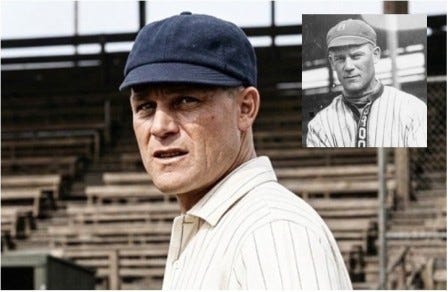
Yes, the mystery photo of the month for March was Norman Arthur Elberfeld, described in the sports pages of the day as the “Tabasco Kid.” Elberfeld managed the Little Rock Travelers to their first pennant in 1920 and faded into history. Kid Elberfeld will be my feature story in Only in Arkansas later this month.
By the time I pushed the send button to publish last week’s Backroads and Ballplayers Weekly, made my sandwich, and sat down to watch Tracker, Loyal Reader Kenny Nichols had texted me the correct answer. Kenny was out in Arizona for Spring Training. About 10 minutes later, my old photo expert, Ronny Clay, submitted another correct response. So much for a difficult Mystery Photo of the Month!
Yes, up to this point on Monday, March 16, about 10 more of you also got it right!
______________________________
If you do not want to miss these posts, you can subscribe or save the address of the Backroads and Ballplayers Facebook Page. Instructions below:
A Subscription sends these weekly posts to your mailbox. There is no charge for the subscription or the Backroads and Ballplayers Weekly.
If you don’t want to subscribe, you can find the weekly posts on Monday evenings at Backroads and Ballplayers on Facebook. SAVE THE LINK
If you receive this post by email on a desktop, you may prefer the desktop version.
Screwballs…
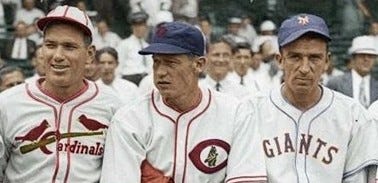
Last week’s Dizzy and King Carl story initiated a lot of discussion about Hubbell’s dependence on a screwball as his “out pitch.” The unnatural pronation of a pitcher’s arm was dangerous, “they” said. The human arm could not hold up for a career using the scroogie 20, 30, or 60 times a game.
Nonsense, declared the outspoken authority on the subject, who held a PhD in kinesiology from Michigan State. If a pitcher throws the screwball correctly, he can throw it any number of times, almost every day, for a long, successful career.
The kinesiologist was so convinced that his research was correct that he became obsessed with proving he was right. To test his theory, he spent 14 seasons in Major League Baseball, serving as a human lab rat to defend his hypothesis.
What do you think about the one-season pitching record below? It looks like a stat report in a Strat-o-Matic league with no rules:
Games - 106, Innings Pitched - 208, Wins - 15, Losses - 12, Games Finished - 83, Saves - 21, ERA - 2.42
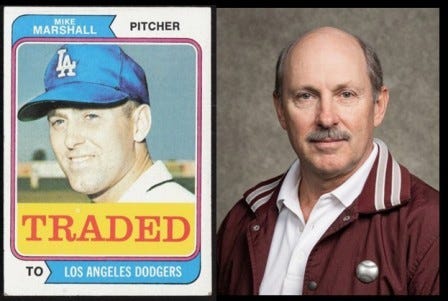
The pitching stats above are very real. Dr. Mike Marshall, the guy with the doctorate and the rubber arm, accomplished that feat, pitching for the Los Angeles Dodgers in 1974. By the way, Marshall won the Cy Young Award. The modern record of 106 games-pitched in 1974 is now more than 50 years old, and it does not seem in danger.
While pitching in more than 100 games seems outrageous, others were testing the traditional limits for pitchers in the mid-1970s. Johnny Sain was sure four days’ rest between starts was not a recuperation time set in stone. Sain called on knuckle-ball savant Wilbur Wood to be the starting pitcher an average of 45 times a season from 1971 to 1975. Wood averaged about 335 innings pitched per season during that stretch.
Perhaps more incredible was Nolan Ryan’s historic feat on June 14, 1974. In the highest recorded pitch count in a modern MLB game, Ryan threw 235 pitches in a 13-inning game.
Although “Iron Mike” Marshall never sold his theory about rest and screwballs to most of baseball’s pitching coaches, he continued to advocate for his philosophy after his pitching career ended in 1981. Marshall was named to two All-Star teams, won the Cy Young Award in 1974, and placed in the top five for the award five times. In January of 1988, Marshall brought his revolutionary ideas to Arkadelphia, Arkansas.
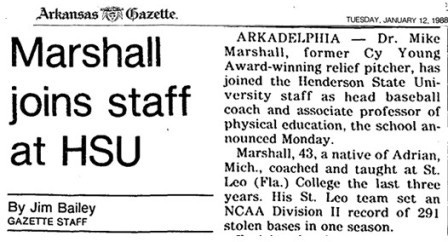
The Henderson Reddies were members of the Arkansas Intercollegiate Conference (AIC). Baseball was a non-revenue-producing sport for AIC schools, and conference members struggled financially to support what was called the “minor sports.” Baseball was one of those.
Seldom coached by a full-time baseball coach and burdened by bad weather, unimproved fields, and little financial aid for players, baseball was sometimes difficult to support. Despite the obstacles, hard-working coaches and players who loved the game created a competitive level far beyond what could reasonably be expected. Marshall was probably surprised by the level of play in the AIC.
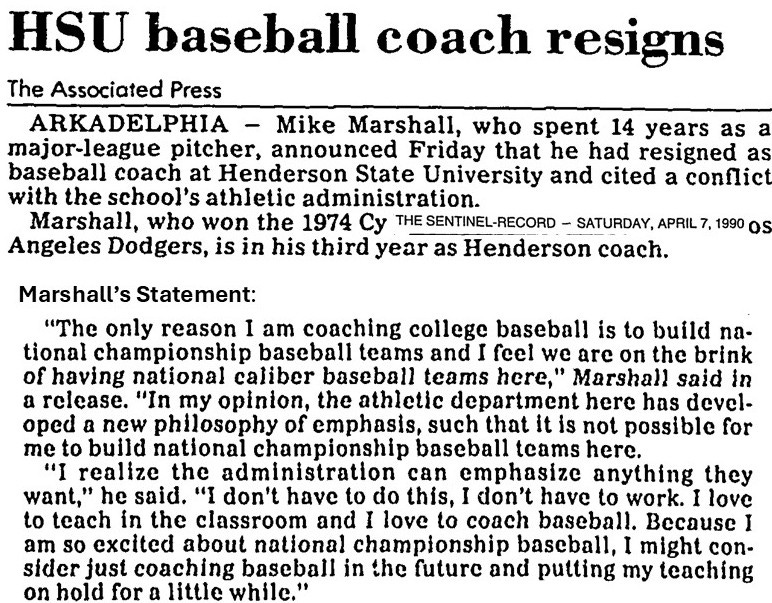
Although the Reddies had not won a title since 1982, Henderson had a reputation for good baseball. The obstacles were frustrating and perhaps more insurmountable than the former Cy Young winner could have imagined. Mike Marshall stayed at Henderson for three seasons. worked hard and won the respect of his players. His teams never contended for a title, nor was he ever comfortable heading a “minor sports” program.
After going 12-12 in the AIC in his first year, Marshall’s Reddies fell to 11-13 in 1989 and 9-15 in 1990. Along the way, he struggled to accept the inattention baseball received at the NAIA level, and by the spring of 1990, he submitted his resignation effective at season’s end.
A personal note:
Mike Marshall was famously known for refusing to sign autographs during most of his career. He believed that signing autographs contributed to the unwarranted "hero worship" of athletes and often told young fans to seek signatures from teachers instead. Mike Marshall autographs are still rare.
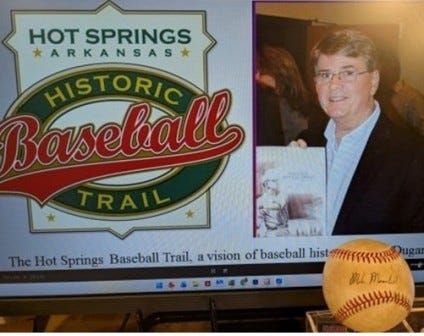
Marshall did not make friends quickly or perhaps intentionally, but it was impossible not to become a friend to Mike Dugan. Dugan, who was the Henderson Sports Information Director at the time, had no acquaintances; everyone who met him became his friend. One day, probably after a big Reddies’ win, Mike happened to mention that “my friend Jim would love to have your autograph.”
The photo below is my prized official AIC baseball autographed by Mike Marshall.
_________________________
The Lost Story of Rube and Baldy, 1919
Mike Marshall believed that kinesiology, not workload, was the secret to a pitcher’s arm health. He would certainly point to today’s fewer innings expected from starting pitchers and the higher percentage of elbow and shoulder repair as proof of his philosophy. The Marshall theory has support from the long careers of the early 20th-century guys who worked 300+ innings a season on a regular basis. While working on the Mike Marshall connection to Arkansas, I revisited the Travelers teams of the first 25 years of their history and the historic “Baldy and Rube” pitching load of 1919.
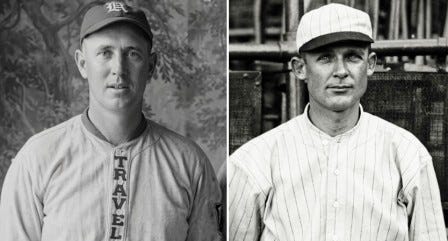
Benjamin Joyce Karr had the typical childhood of professional baseball players of his era. He was born in 1893 and raised on a farm near Mount Pleasant, Mississippi. Although he tried college at Union University in Jackson, when he had the opportunity to sign a pro baseball contract in 1914, he jumped at the chance to “see the world,” he later explained.
It took five unremarkable minor league seasons and a stint in the military during World War I for Karr to reach his breakout season in Little Rock in 1919. He would spend that season working alongside Rube Robinson, the winningest pitcher in Little Rock Travelers’ history.
In 1919, “Baldy” Karr was a prospect on the way to the big leagues when he landed in AA Little Rock. I have no capless photographs of Benn Karr, who spelled his name with two Ns. Eastern Arkansas would soon become Karr’s adopted home, but his story has faded into the shadows of Arkansas baseball history.
Baldy’s new teammate, John Henry Roberson, a farmer from Floyd in White County, Arkansas, had unmistakable major league talent. He also had a proven determination to spend his career pitching in Little Rock, Arkansas. The season before (1918), Roberson, known in pro baseball as Rube Robinson, had reluctantly pitched for the Yankees when the Travs were forced to end the season early due to the workforce demands of World War I.
Rube probably depended on his Travelers’ salary to supplement his farm income for the upcoming winter. With few other choices, he pitched 11 games in July and August of 1918 for the Yanks. On August 12, Robinson beat the Red Sox’s top pitching prospect, a young lefty named Ruth. Three days later, he picked up his check and left for Floyd.
In 1919, Rube Robinson would be joined in Little Rock by another free-thinking farm boy from Mount Pleasant, Mississippi. Although Karr would soon buy a farm in Eastern Arkansas, 1919 would be the only year that the Mississippi farmer called Baldy would be on a pitching staff with Rube Robinson. It would be a historic summer for Baldy and Rube.
The 1919 Travelers had recovered from last place in 1915 to a contender in the shortened 1918 season. The 1919 version was even better, spending the season near the top of the standings before fading to second place, seven games behind the Atlanta Crackers.
Rube Robinson won 23 games, and Karr won 21. They both appeared in a league-leading 42 games. Karr and Robinson combined to pitch more than 600 innings, and Baldy’s 336 innings pitched led the Southern Association. Robinson was going nowhere by choice, and Baldy Karr was headed for the Major Leagues.
Karr reported to a 1920 Boston Red Sox team in decline. Boston had sold Babe Ruth to the Yankees the week after Christmas of 1919, and an unhappy fan base watched their home club take their usual place in the American League’s second division.
The Red Sox used Karr as a mop-up pitcher in games that were out of reach in 1920. He posted a 3-8 won-loss record and led the league in games finished. He had a little better record in 1921 (8-7, 3.67 ERA), but 5-12, 4.47 ERA in 1922 led Boston to release Karr back to Atlanta in the Southern Association, where he once again became one of the SA’s leading pitchers.
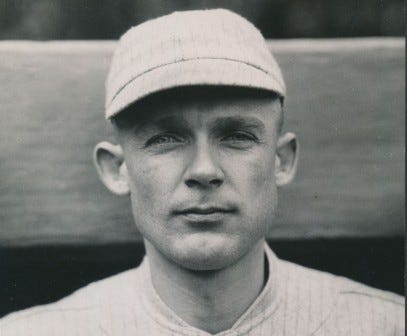
Two years with 44 pitching wins and a sub 3.00 ERA earned him another chance. This time with Cleveland, he produced three more unremarkable big-league seasons and a final demotion back to the Southern Association.
By 1931, Karr had purchased a farm near Marion, in Crittenden County, Arkansas. He pitched 108 innings as a reliever and sixth starter for the second-place Travelers.
The Karr farming operation eventually moved to Gould in Lincoln County. Benjamin J. Karr died in 1968 in a Memphis hospital at age 75.
________________________