
Backroads and Ballplayers #143
Stories of the famous and not-so-famous men and women from a time when baseball was “Arkansas’ Game.” Backroads and Ballplayers Weekly is always free and short enough to finish in one cup of coffee.

If you do not want to miss these posts, you can subscribe or save the address to the Backroads and Ballplayers Facebook Page. Instructions below:
A Subscription sends these weekly posts to your mailbox. There is no charge for the subscription or the Backroads and Ballplayers Weekly.
If you don’t want to subscribe, you can find the weekly posts on Monday evenings at Backroads and Ballplayers on Facebook. SAVE THE LINK
If you receive this post by email on a desktop, you may prefer the desktop version.
_________________________
New Mystery Photo, Dizzy Dean and “King Carl,” Working for Hornsby, and How to Watch the Cards or Your Team
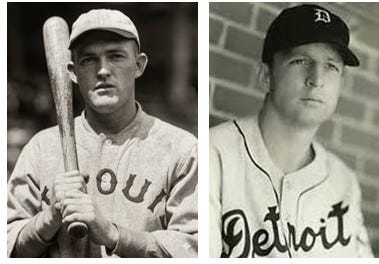
Mystery Photo March 2026
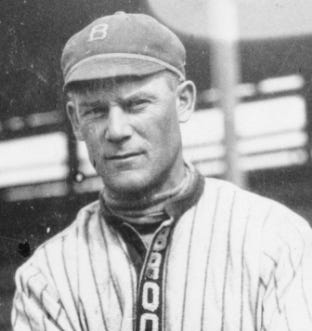
Hint - Our mystery guy was the toast of the town, until he wasn’t! He stormed across Major League Baseball for about a dozen seasons, adding a little fire to every team he played for and managed.
If you already think you know, send me a message.
__________________________
Dizzy Dean and “King Carl”
Dizzy Dean probably did not like Carl Hubbell before they ever met. Hubbell was about seven years older than Diz, and by the time the Deans moved to Oklahoma in 1925, Hubbell was already a local star.
Hubbell had grown up on a pecan farm in the small town of Meeker, about an hour’s drive from Spaulding, Oklahoma, the Dean family’s first stop after moving from Chickalah in Yell County, Arkansas. In 1925, Hubbell was the ace of the staff on the Oklahoma City Indians in the Class A Western League.
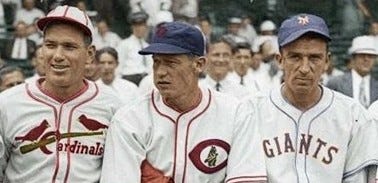
When Diz made the major leagues for good in 1932, there was Carl Hubbell again. In 1933, when Dizzy won 20 games for the fifth-place St. Louis Cardinals, Hubbell won 23 games, a World Series, and an MVP award. To make matters worse, the press called Dizzy’s rival “King Carl.”
Diz flipped the script in 1934 when the “Gas House Gang” and the Dean brothers became the biggest story in baseball. Diz won 30 games, the World Series, and the MVP award. It looked like the Gas House Gang had taken the headlines from the Giants for years to come, but it would be the legendary assortment of unique characters’ only championship.
In 1935, the Cubs, led by Arkansas’ affable country-boy pitcher Lon Warneke, won the National League pennant, and El Dorado’s Lynwood Rowe won a World Series. Diz and Paul continued to pitch well, but the “Arkansas Hummingbird” and “Schoolboy” Rowe stole the headlines both nationally and in Arkansas.
Hubbell won the MVP award again in 1936, and Diz finished second in the vote. The Giants captured another National League pennant, and King Carl won his last 16 decisions. The Dean-Hubbell rivalry had grown personal, and each time the Future Hall of Famers pitched against each other, the game received national attention. The most significant of these matchups came on May 19, 1937.
In the baseball story of Dizzy Dean’s life, most historians point to the 1937 All-Star Game and the line drive that broke Dean’s toe as the impetus for his eventual decline. That isolated incident is correctly identified as the turning point in Dean’s career, but the rest of the story leads back to that game two months earlier.
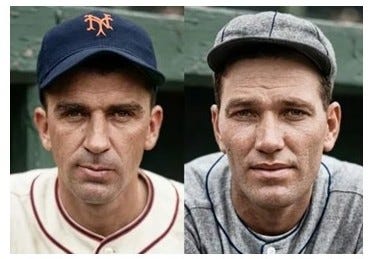
Entering the May 19 game, Hubbell had extended his winning streak to 21 games. Diz was 5-1 with a 1.09 ERA. The game began a pitcher’s duel, as advertised. Through five innings, the Cardinals led 1-0 on a second-inning home run by Joe Medwick. Dean was cruising along until he lost his composure in the sixth inning.
Burgess Whitehead led off with a single to right field, and Hubbell moved him to second base with a bunt. With the count one and one on Dick Bartell, Dean turned, faked a throw to second base, and in one motion threw to the batter. Bartell hit a pop fly to short left field. In a moment in time that changed Dizzy Dean’s life, Umpire George Barr called a balk.
Dean blew his top, threw his glove into left field, and the ball into right field. It took several minutes to restore order, but for some inexplicable reason, Diz was not ejected. Bartell returned to the plate, and Diz threw at him a couple of times before he hit a fly ball to right field.
If things were not already deteriorating, right fielder Pepper Martin dropped the easy out, scoring Whitehead from third. Another mis-played fly to the outfield and a single scored two more runs. Dizzy Dean’s nightmare inning eventually ended with the Giants up 3-1.
Before the game ended in a 4-1 Giants’ victory, several confrontations finally erupted into a bench-clearing brawl in the ninth inning. A couple of ejections ended the game, but not the incident’s role in the baseball life of Dizzy Dean.
Although his part in the incident was obvious, Diz was not ejected. He was fined $50 in what seemed to be the end of an ugly situation, but not to Diz. His comments about umpire Barr soon became an ongoing battle of words between Dean and league president Ford Frick.
The battle of wills reached a critical public turning point for the president about a week after the balk incident, when Dean criticized Frick openly at a father-son banquet that drew widespread newspaper coverage. Dizzy used the word “crook” to describe the league president and the umpire who called the balk a few days earlier. In a time when organized crime was still an emotional issue in America, being called a crook was a slanderous characterization. Above a newswire photo of Dizzy signing an autograph for a young fan, the headline read, “Dizzy Dean Assails National Loop President And Umpire Barr At Father-Son Dinner Here.”
Dean had taken the conflict to a new level, and the president reacted in a way that would soon place his office in a no-win position. On June 3, Frick announced that Diz was suspended until he made a remorseful public apology.
Ford Frick had taken a decisive stand, but Dean did not flinch. It would take some significant negotiations, mostly between the Cardinals and the league president, to find a way out of Frick’s ultimatum. The All-Star Game was just over a month away in the nation’s capital, and President Roosevelt would throw out the first pitch. Baseball needed Dizzy Dean, and the popular pitcher knew he was operating from a position of power. Dean defiantly responded with three public threats:
1. To quit baseball and spend the rest of the summer in Florida
2. To offer his services to semi-pro teams
3. To call his wife
Perhaps Diz viewed the third alternative as the most serious.
The next day, the Cardinals persuaded their ace to participate in a phone interview that would allow Frick to save face. The two-hour session resulted in Dizzy’s reinstatement but offered little in the way of a capitulation on his stance. “Well, I won my point, I said I wouldn’t sign anything, and I didn’t sign anything,” Diz stated proudly.
In the much-repeated story of that All-Star game, a line drive off the bat of Earl Averill hit Dizzy Dean on the left foot, and caromed to second baseman Bill Herman, who threw to first for the out. A jubilant National League team celebrated their good fortune as they ran from the field, but Dizzy did not join the celebration. He could barely walk on what would later be diagnosed as a broken big toe on his left foot. The injury and the damage caused by an unnatural delivery produced irreparable damage to his arm. He would have some moderate success after being traded to the Cubs, but he would never be the same pitcher.
In hindsight, the intensity of the Dizzy Dean/Carl Hubbell rivalry may have been the cause of the outbursts in the game of May 19, and what about the apology? Had Dean’s suspension remained in effect, he would have had to sit out the All-Star Game. What would his career have been like without the injury?
At the conclusion of the 1937 season, Carl Hubbell had won 192 games, Dean’s record was 134-75. He would win only 14 games the remainder of his career. In seven seasons with the Cardinals, Dizzy Dean started against Carl Hubbell 10 times, with Hubbell winning 6 and Dean winning 4.
Links to players and events from this post:
______________________
Playing for Hornsby
“People ask me what I do in winter when there's no baseball. I'll tell you what I do. I stare out the window and wait for spring.” —Rogers Hornsby
Rogers Hornsby was one of the greatest hitters of all time. Consumed by his love for the game, he became a demanding manager who expected complete dedication from his players.
During his active years in the majors, Hornsby played several exhibition games in Arkansas. After his retirement, he spent his summers working and sponsoring baseball summer schools in Hot Springs.
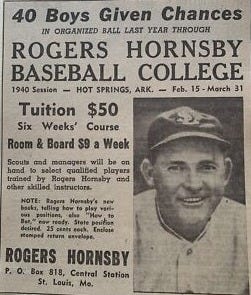
Rogers Hornsby:
Triple Crown Winner: 1922, 1925
MVP Awards: 1925, 1929
Batting Titles: 7 (1920–1925, 1928)
Highlights: .358 BA (2nd all-time), 301 HRs, 1,584 RBIs, 2,930 hits
Record: .424 batting average in 1924 (highest modern single-season record)
Teams: St. Louis Cardinals, New York Giants, Boston Braves, Chicago Cubs, St. Louis Browns
Baseball Hall of Fame
Managerial & Post-Playing Career
World Series Champion: 1926 (Player-Manager, St. Louis Cardinals)
Managerial Roles: Cardinals (1925–1926), Giants (1927), Braves (1928), Cubs (1930–1932), Browns (1933–1937, 1952), Reds (1952–1953)
Post-Career: Operated a baseball school in Hot Springs from 1939 to 1952
________________________
Strike Three? You’re out $100
You didn’t smoke in Rogers Hornsby’s locker room. In fact, you didn’t eat, drink a soft drink, or maybe worst of all sins, laugh! The old Rajah was one of baseball’s greatest hitters and certainly one of its greatest tyrants as a manager.
Among his unusual rules was that if the count is 0-2 in favor of one of his pitchers, the next pitch had better be under the hitter’s chin or at least an unhittable ball. The cost of a 0-2 strike was a $100 fine.
James Elton Walkup was undoubtedly intimidated by the uncompromising Hornsby, and the rookie from Havana, Arkansas, needed the $100. Whatever the motivation, and certainly due to an unfortunate wild streak, when Elton Walkup threw three straight strikes that memorable game in 1935, he undoubtedly panicked. He argued so vehemently that the third strike was actually a ball that he had to be restrained by his teammates. Surely one of baseball’s strangest moments in baseball history. A pitcher arguing against a call that went his way.
_________________________
$100 and a New Roster

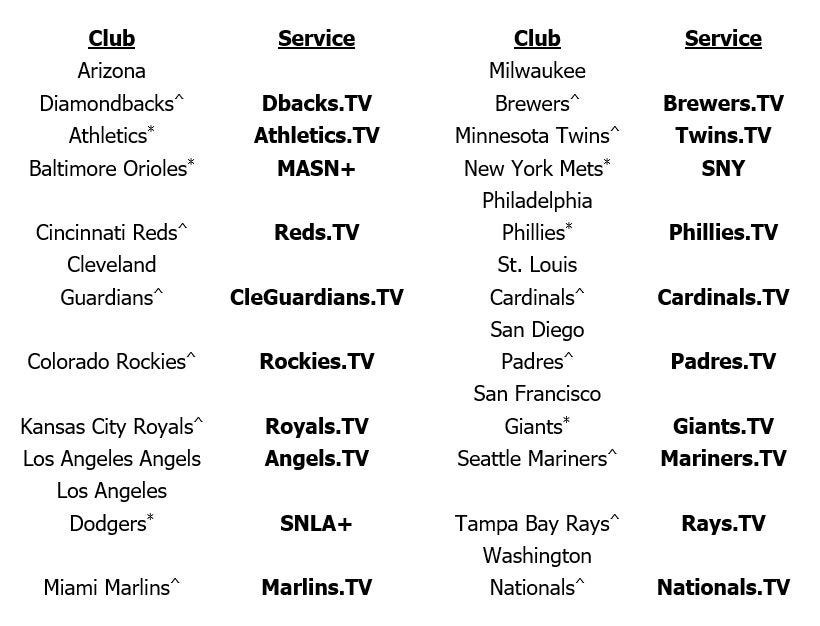
I have been asked several times about a streaming subscription to St. Louis Cardinals games now that FanDuel is no longer a provider. The MLB Network seems to be the best choice for most of us here in Arkansas. Below is the link to the MLB Cardinals.TV (or your team) with a description of options and an ordering website.
Last summer, our FanDuel subscription also streamed Royals games as part of the package. That is not part of this season’s Cardinals.TV package. I will miss the Royals.
How to proceed: Go to the link provided, choose your plan, and your payment choice.
I have decided on the CARDINALS.TV option.
The MLB.TV & CARDINALS.TV option adds all other teams to the CARDINALS.TV package.
The MLB.TV option will include every team not subject to regional blackouts. (Royals, Rangers, and Cardinals are the blackout teams for this region)
MLB+ is essentially radio
For those of you fortunate enough to support a team with some hope of success, here are the teams with similar 99.99 products…
________________________
Note: Some photos are colorized versions of black and white photographs. Only free rights photographs or non-copyrighted photographs are colorized and will be marked. (cl)