
Backroads and Ballplayes #147
Stories of the famous and not-so-famous men and women from a time when baseball was “Arkansas’ Game.” Backroads and Ballplayers Weekly is always free and short enough to finish in one cup of coffee.

See You in Charleston! Roaring 20s Part III: Ray Winder & Bill Dickey, Slow Starts, Mystery Photo,
How about Saturday Morning in Charleston?
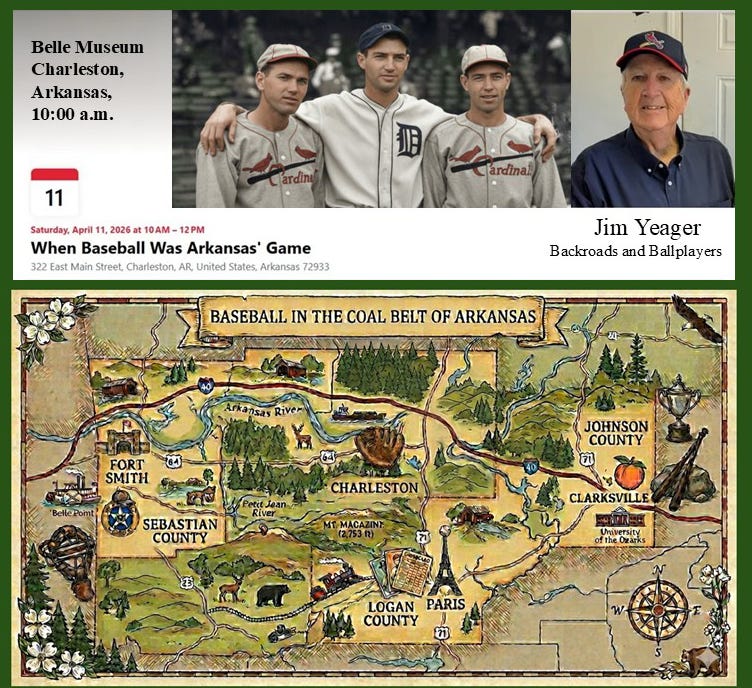
I grew up in Franklin County, Arkansas, but in my younger days, Charleston, Arkansas, seemed 100 miles away. The rugged Boston Mountains still dominate the landscape of my part of Franklin County, but in the southern part of the county, cattle farms and small towns replace the Ozark mountain region.
You can still find a neglected backstop in some of those South Franklin County communities to remind travelers of a time when baseball was “Arkansas Game.”
I have been looking forward to my morning at the Belle Museum in Charleston, where I will share the lost stories of baseball in the Coal Belt of West Central Arkansas (Johnson, Franklin, Logan, and Sebastian Counties).
Some stories recount successful careers while others reveal hardships and failure. These tales are about baseball, but they also highlight the cultural importance of the game in some of our state’s darkest days.
I hope you can join me for an hour devoted to your grandparents’ game.
_________________________
High Expectations and Bad Starts - Temporary or Significant?
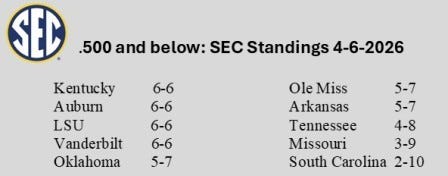
“Plenty of teams are feeling the pressure in 2026 – don’t forget the_______.”
—The Athletic, April 3, 2026
The headline above appeared in The Athletic three days ago. How important is it for a team to get off to a good start? Which team’s fanbase is most concerned, surprised, or hopeful?
One or more of those teams will reach the regional round of the NCAA Baseball Championships. (perhaps host) SEC teams with a winning conference record seem almost guaranteed to host a regional.
Pick one:
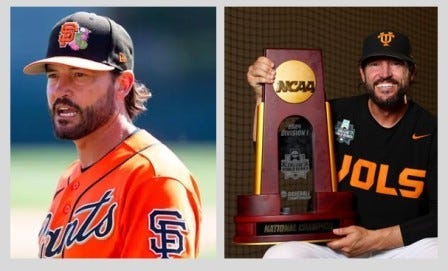
Actually, that headline referred to the San Francisco Giants.
______________________________
Mystery Photo of the Month, April 2026
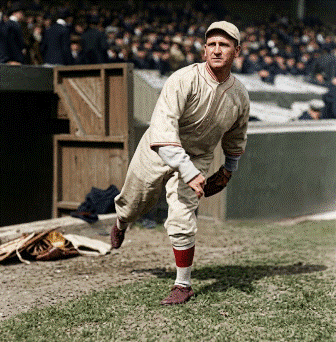
A son of the Coal Mines, he was way too good to be a “Mystery Photo.”
Already know this guy?
________________________
If you do not want to miss these posts, you can subscribe or save the address of the Backroads and Ballplayers Facebook Page. Instructions below:
A Subscription sends these weekly posts to your mailbox. There is no charge for the subscription or the Backroads and Ballplayers Weekly.
If you don’t want to subscribe, you can find the weekly posts on Monday evenings at Backroads and Ballplayers on Facebook. SAVE THE LINK
If you receive this post by email on a desktop, you may prefer the desktop version.
_________________________
Roaring 20s Part III: Ray Winder in the 1920s
Ray Winder arrived in Arkansas in 1905, before his twentieth birthday. In what seems like a business venture from a western movie, he and his father opened a livery stable in the heart of the city. Although the young merchant would not be officially associated with professional baseball until 1915, the first ten years of his life in Little Rock provided a unique opportunity for a fledgling executive to develop into the popular city leader and the skilled businessman he later became.
Winder found a group of outgoing young people almost immediately. While the term “networking” was yet to be associated with making contacts, Ray Winder was following the yet-to-be-written script. He served on the dance committee for the Century Club, joined a group of young businessmen in an exercise club at the YMCA, and played some baseball. Although he later downplayed his baseball ability, Ray was good enough to be the catcher and play some outfield in the local semi-pro league.
After the Travelers folded in 1909, the City League attracted some local men with pro experience and became the only high-level baseball played that summer, in a city without a minor league team. Ray Winder’s name appeared often as a regular for teams called the Martins, Lloyds, and Electrics. He also played on a championship indoor baseball team called the Ponies in the local YMCA league. Between Winder’s social activities and his baseball, he was in the news often, including the announcement of his wedding to Miss Zipporah Karr in September 1909.
In December 1911, the Winder Livery Stable suffered a total loss in a devastating fire in the downtown area of Little Rock. Ray’s father, Asbury Winder, estimated the losses at $30,000, including the death of personal horses and those animals boarding at the facility.
After the fire, The Arkansas Gazette editorialized that downtown was no place for a loud, smelly, fire-prone livery stable. The resilient Winders agreed to move east toward what is now the River Market District, and the Winder Livery Stable reopened for business about three months later.
When the Travelers baseball franchise was revived in 1915, new owner R. G. Allen began to find part-time assignments for Winder. Allen needed a local, well-respected point man, and Ray Winder fit the bill. For the next few years, Winder the baseball executive and Winder the businessman coexisted.
Leaving the day-to-day operation of the livery stables to his father, Winder managed various business-related tasks for the Travs, served as road secretary, and did public relations work. In addition to his newly acquired baseball positions, he was appointed clerk of the Little Rock Municipal Court.
Always the entrepreneur, Winder later added a dance hall and dance lesson academy to his occupations. The “Place for Respectable Ladies and Gentlemen” charged $1 per couple for an entire evening or 10 cents a dance for more frugal customers.
Allen and Winder pieced together a 1915 Travelers club with some locals and cast-offs, but as expected, the team finished last in the Southern Association. After an off-season of networking and scouting, the two Little Rock executives assembled a first division roster in 1916. Baby Doll Jacobson hit a league-leading .346, and Arkansas farm boy Rube Robinson won 11 of 12 decisions down the stretch. The popular club drew more than 90,000 fans to the newly named Kavanaugh Field. The two young Little Rock moguls had built a winner in one short year and established a lifetime friendship that would be mutually beneficial.
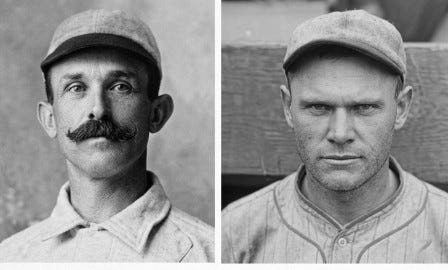
The 1917 baseball season began two years of hard times brought on by a raging pandemic called the Spanish Flu and an increasingly dangerous conflict in Europe. Rosters were unstable, and teams scrambled for players not affected by illness or a call to active military duty.
The Little Rock roster was in a constant state of flux. Baby Doll Jacobson was now in the majors, and, although Rube Robinson remained one of the SA’s most dependable hurlers, most of his fellow pitchers were inexperienced. The 1917 Travelers slipped back to seventh place.
By the 1918 campaign, the situation was even more unstable. Winder became the official secretary of the Travs when Robert Allen Jr., son of the owner, enlisted in the military. Winder and Robert Allen Sr. coaxed a fiery baseball man, Norman “Kid” Elberfeld, to come on board as manager. The Winder-Allen leadership team also created a competitive roster that found the Travs in second place in mid-July when the Southern Association was forced to end the season in response to the increased demands of a war effort.
Baldy Karr, a farm boy from Mississippi, joined with Rube Robinson to give the 1919 Travs the best one-two starters in the Southern Association. The Travelers finished a strong second in the SA and drew 99,000+ to home games at Kavanaugh Field. The 1920 Travelers set an attendance record that lasted more than 30 years. Read the story of the 1920 Southern Association Champion Little Rock Travelers.
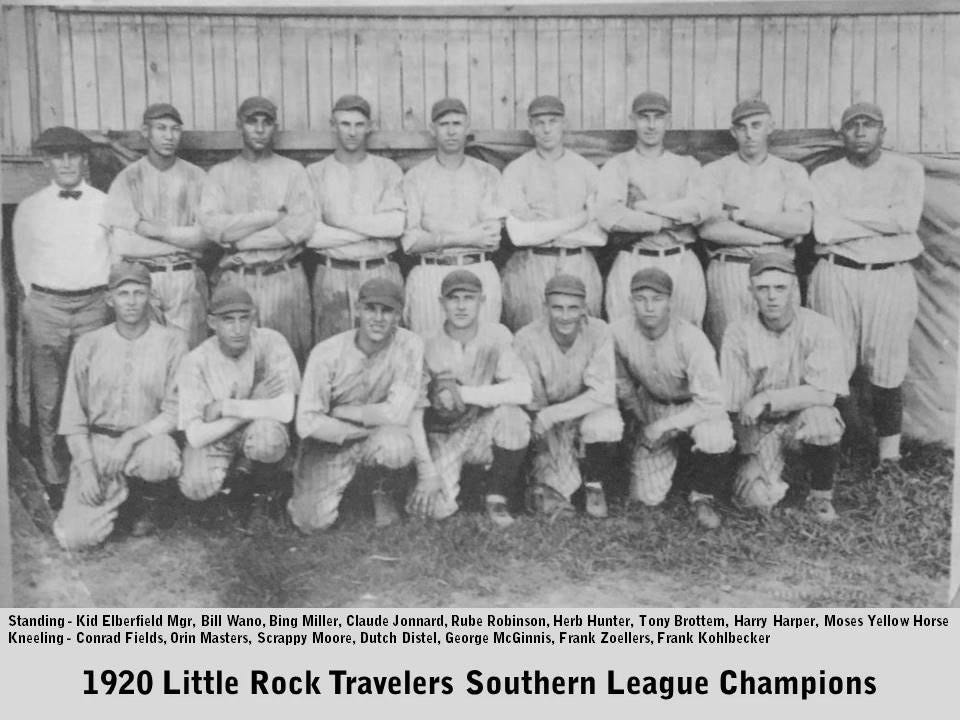
In Arkansas, the 1920 Little Rock Travelers had made a significant local contribution to the better times to come. The Southern Association Champion Travs gave Little Rock the feel-good story the city needed to recover its collective optimism. Ray Winder and the Allens had recruited a historic mix of locals, rising stars, and seasoned veterans to win Little Rock’s first baseball pennant. More than 165,000 fans saw the Travelers win the Southern Association title, but Ray Winder was restless.
In 1921, fortified with a gentleman’s agreement with his friend Robert Allen to send some players his way, Ray Winder decided to venture out on his own as a general manager. He won a playoff at his first stop with Chickasha, Oklahoma, in the Western Association and posted successful campaigns at Joplin, Muskogee, and Knoxville before returning to Little Rock in 1929.
Along the way, Winder’s teams featured some of the Travelers’ most promising prospects and some of Arkansas’ best young semi-pros getting their first shot. Winder’s teams became the staging area for pro baseball prospects from Arkansas.
White County’s Homer Adcock was the ace of several of Winder’s teams. Drap Hayes, his old pal from the Little Rock City League, joined him in Chickasha and Muskogee, and career minor leaguers, Thorpe Hamilton, Lefty Ingram, and Jimmy Johnson, were sent his way by his connections in Arkansas.
In his three seasons at Muskogee, Winder not only mentored future Hall of Famer Bill Dickey but led teams that included three star-crossed men whose stories are among the most poignant in Arkansas baseball history. Atkins’ Fred Bennett, Greenbrier’s Otis Brannon, and Northwest Arkansas’ Pea Ridge Day were among the most promising young players in the minor leagues when they joined Winder in Muskogee. Although all three reached the major leagues, their stories are dominated by what might have been.
The 1920s would be the only decade after his arrival in the state that Ray Winder was not directly involved in the operation of the Arkansas Travelers, but his heart was always in Little Rock. He would return to his adopted hometown in time to be part of the greatest period in Arkansas baseball history.
_________________________
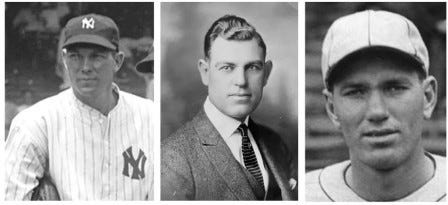
Bill Dickey and Ray Winder, 1926
In May 1926, Bill Dickey was going home. He was 19 years old, but so discouraged with pro baseball that he was giving up. He had started the season in Little Rock with lofty expectations, but after less than a month, his batting average hovered around .200, and his defense was worse. The intricacies of catching were a mystery.
When things looked hopelessly bleak for the discouraged young catcher, he caught a break. On May 8, a Little Rock franchise in a financial crisis sold Dickey to the Minneapolis Millers. The Travs, heading for the Southern Association cellar and struggling at the gate, needed cash flow more than a .200-hitting catcher who seemed lost behind the plate.
Although Minneapolis had high expectations for their new prospect, he was not ready to be a starting catcher in Class AA, one step below the majors. The Millers sent Dickey down to Muskogee in the Western League to a team where fellow Arkansan Ray Winder was general manager. Winder immediately recognized a teenager in a career crisis, but the Muskogee executive’s expertise was not catching skills. He had something else to offer Bill Dickey.
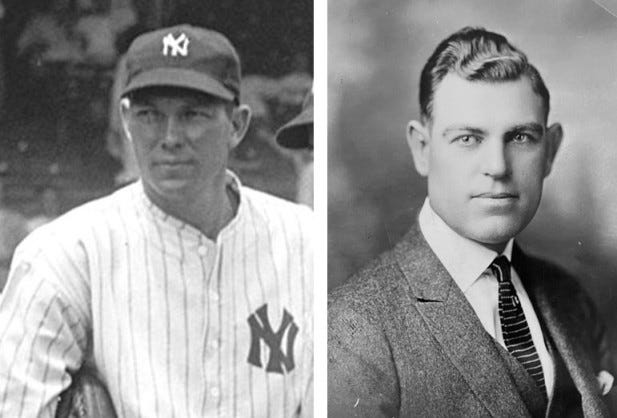
Dickey would later explain, “[Winder] sat down and talked to me like a father.” The general manager convinced his young catcher that he had what it took to be a big leaguer, but it would not be easy. “Why don’t you give it a year at least? You have played for less than a month.”
Dickey went to work on his skills, and, with Ray Winder as his personal career counselor, he was soon on the right track. Unfortunately, the Muskogee franchise folded in mid-July, but, once again, Winder arranged a situation for Dickey that led to even more success.
The rejuvenated young catcher finished the year back in Little Rock and continued to thrive in familiar surroundings. While their shared Arkansas connection drew Winder to Bill Dickey, the general manager also saw something in his protégé that others had missed. In 1954, Winder’s reclamation project of 1926 was inducted into the Baseball Hall of Fame.
Five years later, Bill Dickey was chosen for the Arkansas Sports Hall of Fame as a member of the organization’s first induction class. Dickey-Stephens Park, home of the Arkansas Travelers, is named in honor of Bill Dickey, his brother George, and benefactors Witt and Jack Stephens.
_______________________