
Backroads and Ballplayers #163
Stories of the famous and not-so-famous men and women from a time when baseball was “Arkansas’ Game.” Backroads and Ballplayers Weekly is always free and short enough to finish in one cup of coffee.

_________________________
If you do not want to miss these posts, you can subscribe or save the address of the Backroads and Ballplayers Facebook Page. Instructions below:
A Subscription sends these weekly posts to your mailbox. There is no charge for the subscription or the Backroads and Ballplayers Weekly.
If you don’t want to subscribe, you can find the weekly posts on Monday evenings at Backroads and Ballplayers on Facebook. SAVE THE LINK
_________________________
Road Trip, Mystery Photo Revisited, and The Forgotten All-American, Remembering Blane Knight
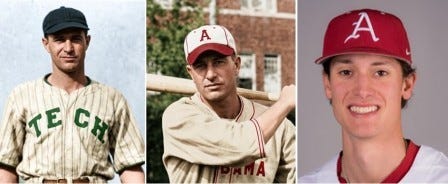
The University of Alabama might not qualify as a “must-see” for researching Arkansans who received national attention in college sports. Last month, I made a road trip to Tuscaloosa, Alabama, to do just that. (AND to visit some of my favorite family members) On my list was John Tucker, the original Wonder Boy, a “Bear” from Fordyce, a Hall of Famer called “Foots,” and an All-American baseball player from Pope County.
I found new information about all four. The story of that “Road Trip” is a feature in Only in Arkansas this week. Please take a few minutes to read and share that adventure, return for Blaine Knight revisited, and a closer look at the lost story of a college baseball star shared by Arkansas Tech and Alabama.
Road Trip Only in Arkansas - Link
_______________________
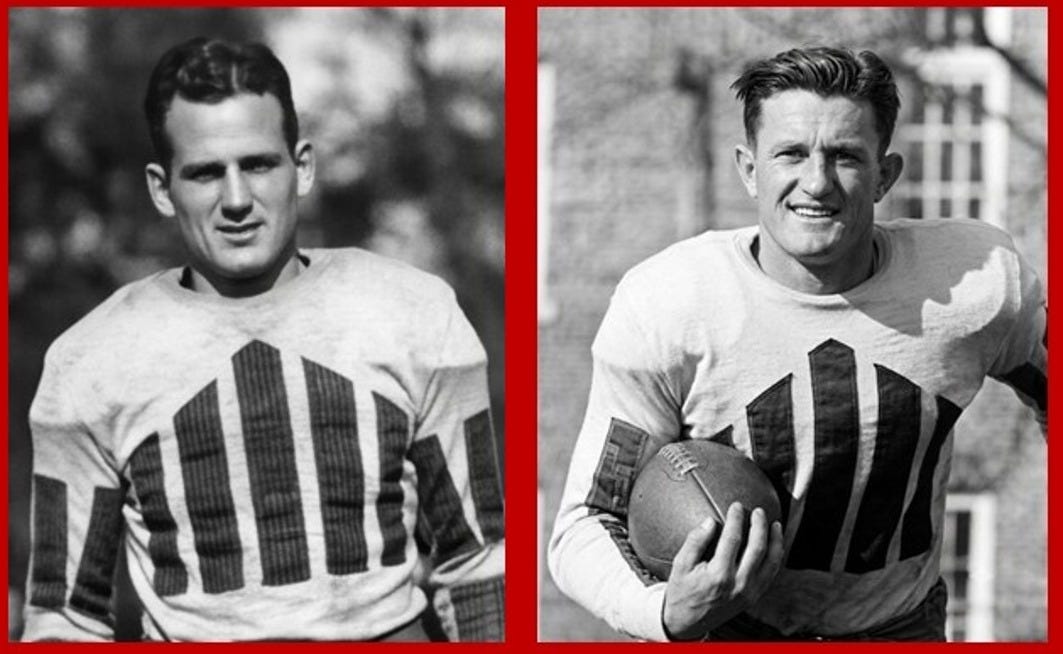
Lost Story: Veo Story
The Forgotten All-American
Hector, Arkansas, is the kind of place that makes a perfect rural hometown. Everyone knows your name in Hector. The school is the center of the community’s social life, and the unspoiled Ozark Mountains begin about a minute from the city limits.
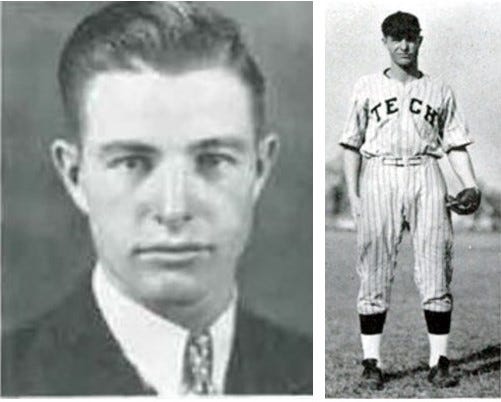
In the first half of the 20th century, the rural hamlet was a tiny unincorporated village. Hector was named after President Grover Cleveland’s dog and the last stop before entering the back roads into the Ozarks. There is no sign outside Hector, Arkansas, welcoming travelers to the home of one of the area’s most successful baseball players.
If there are degrees of “lost,” the sports story of a country boy from the foothills of the Ozarks is one of the “most lost” in Arkansas baseball history. He starred at every level before and after World War II, yet his story has virtually disappeared.
His name is Veo Story. He excelled in three sports at Arkansas Tech, made three All-American teams, played on two SEC Baseball Championship teams, and hit .299 as a professional baseball player. In his shining moment, Story was chosen as the Most Valuable Player in a prestigious national tournament. He is not a member of the Arkansas Sports Hall of Fame nor the halls of fame at the colleges he attended.
Story enrolled at Arkansas Tech in the fall of 1936 and became an immediate starter in basketball and baseball. By 1939, he was the leading hitter on the baseball team, the leading scorer in basketball, and finished second in the pole vault in the state meet, won by Arkansas Tech.
After graduating from what was then a junior college, Story enrolled at the University of Alabama in the fall of 1939. Perhaps Alabama found Story, or Story found Alabama, on the advice of Arkansas Tech coach John Tucker, who had played for the Crimson Tide National Championship football team in 1930. The distance from a farm in Pope County, Arkansas, to the SEC cannot be measured in miles.
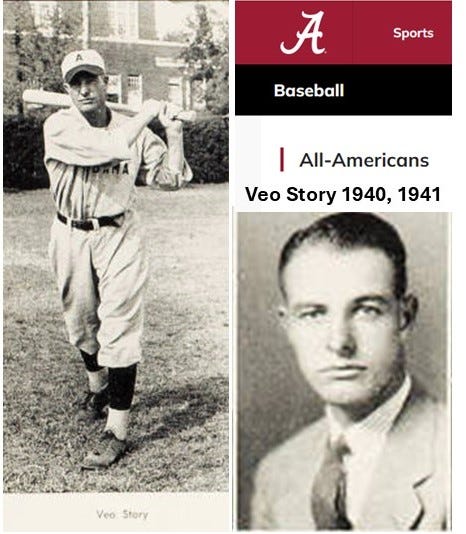
Despite a jump from the AIC to a nationally competitive program, stepping up to the Southeastern Conference was a smooth transition for Veo Story. His “long-range set shot” earned him a spot in the basketball starting lineup, and he batted .340 in his two seasons of SEC baseball. In 1941, after leading the Tide to a second consecutive SEC baseball title, Veo Story was named an All-American for the second time.
After his last season at Alabama, Veo Story signed a professional contract with the Brooklyn Dodgers. That summer, the Dodgers skipped the low minors and placed their new infield prospect directly with the Dayton Ducks, a Class C team with older and more experienced minor leaguers. As he had done when he moved from a tiny rural high school to Arkansas Tech, and later from a small junior college to Alabama, Veo Story became an immediate success.
He batted .312 and led the team in runs scored, games played, and hits. Veo Story was 22 years old and among the younger players on the Ducks. He looked like he was on the fast track to the major leagues. That seemingly inevitable promotion never happened. It was the summer of 1941, and Veo Story’s life was about to take a detour.
The 1941 season was the last season for the Dayton Ducks before World War II. From 1941 until the summer of 1945, Story served his country in the Navy. While in the Navy, Story made headlines in various semi-pro basketball contests. He began as a “Chief Boatswain’s Mate at Naval Training Station Norfolk in March of 1942, but appears to have graduated from the Tunney School and was redesignated an Athletic Specialist and transferred to the Memphis Naval Air Training School in December 1942.
When he resumed his pro career in 1946, minor league baseball had changed significantly. The professional players from the pre-war days were back, but teams were looking for young prospects. Veo Story was now 27 years old and among the oldest players on his Class B Asheville Tourists. Story played in 135 games and batted .298, but at age 27, his time had run out as a big-league prospect. The Dodgers released him to a new Class B team at Reidsville, North Carolina, where he spent most of 1947, before a demotion to Class C in the last month of the season.
At age 28, Veo Story’s professional baseball career was over, but his baseball career had one more shining moment. He spent the summer of 1948 playing for one of the most successful semi-pro teams in the nation, the Chatham Blanketeers, sponsored by the highly successful Chatham Blanket Company in North Carolina.
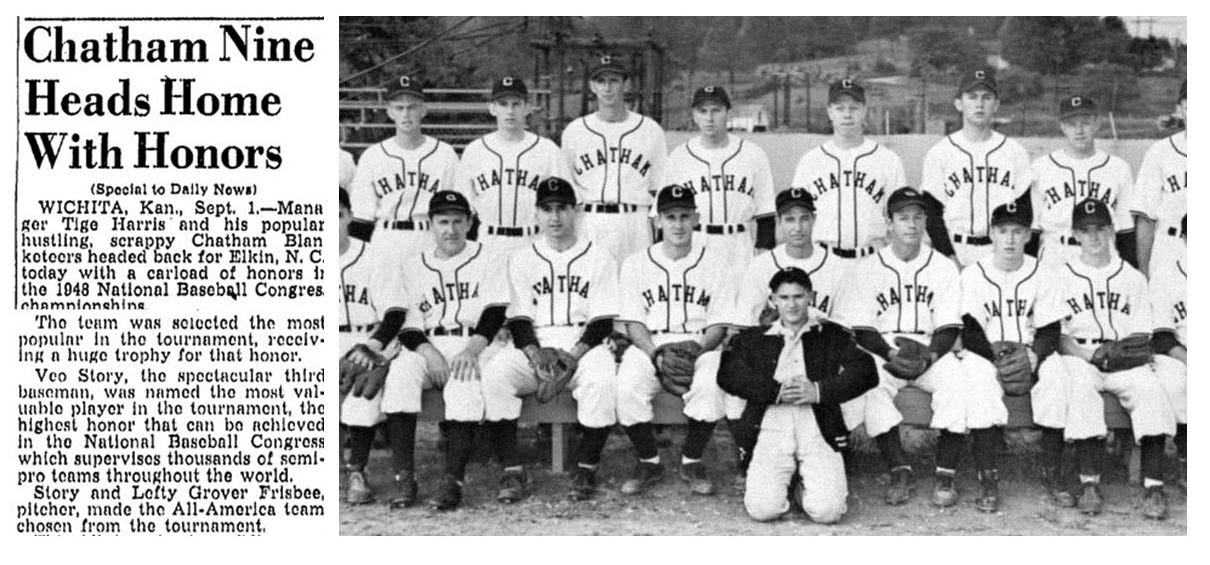
The Elkin/Chatham Blanketeers represented North Carolina in the Semi-pro National Tournament in Wichita, Kansas. The Blanketeers were selected as the most popular team in the tournament and reached the finals before losing to eventual champion Fort Wayne, Indiana, 2-1. Veo Story, the spectacular Chatham third baseman from Hector, Arkansas, was named Most Valuable Player in the Tournament.”
Story spent most of his post-baseball career teaching and coaching in Oklahoma. He died in 2007 in Fresno, California.
Note - Special thanks to the Chatham Blanket Manufacturing Company for the photos above.
_________________________
Mystery Photo: July 2026
Although he played for our “Grandpa’s team,” this turned out to be one of the hardest mystery photos of the series. Many of you have his baseball card!
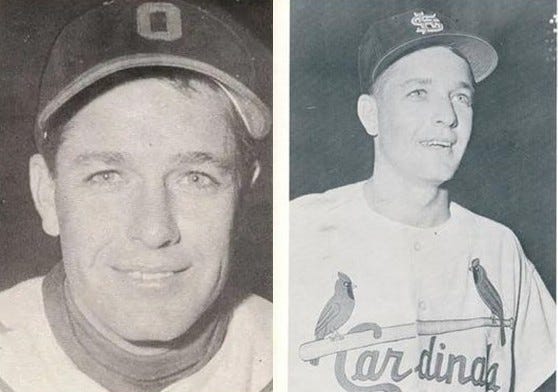
I wore #36 and #19, but my baseball card number was 544.
Let’s get this done!
_____________________________
Final Thoughts…Blaine Knight Revisited
2018!
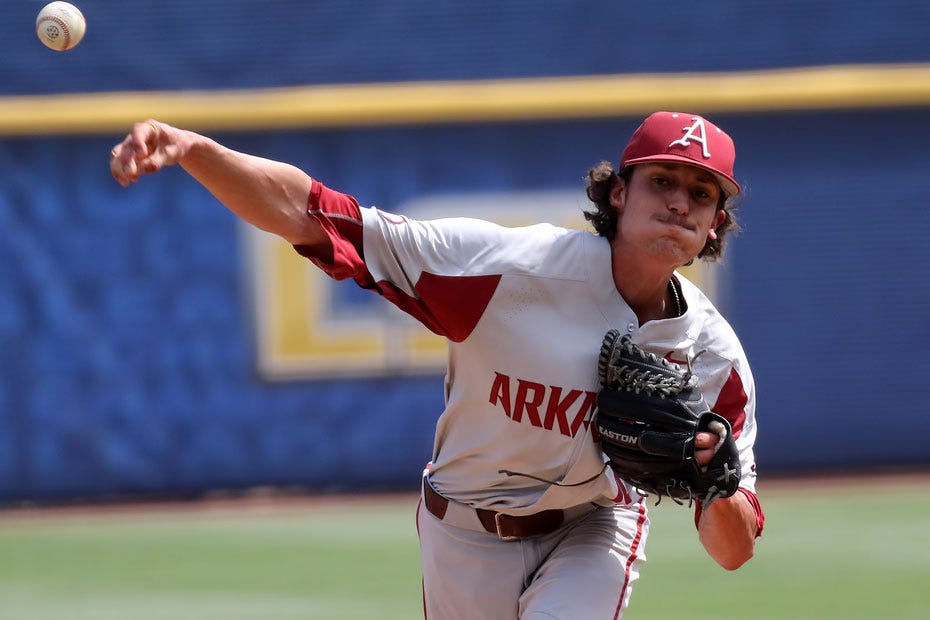
Does it seem like we Razorback baseball fans don’t talk much about 2018? The 2018 Razorbacks deserved a better finale to one of the most successful campaigns in the history of the program. BUT
“[Baseball] breaks your heart. It is designed to break your heart. ―A. Bartlett Giamatti
Remember, Casey Mize of Auburn was the first player taken in the MLB Draft. Florida’s Brady Singer was taken 18th. Arkansas’ ace, Blaine Knight, was the ninth pick in the third round.
The first-round SEC draftees have one thing in common. They both lost their SEC start to Blaine Knight. Mize and Singer were both considered can’t-miss Major League pitching prospects. Knight was marginal. He had a thin frame, and his indicators were iffy, but he posted a 14-0 record that resulted in a much better signing bonus than his draft slot.
Basically, the scouts who predicted those things were correct. Singer has been pretty good, and after the seemingly inevitable Tommy John surgery, Mize seems to have found his old mojo at age 29. Blaine Knight spent five seasons in the minors and never threatened to become a big leaguer.
While I was writing about Kevin Kopps and Hagen Smith, I realized that perhaps Blaine Knight deserves to be mentioned in the same sentence as those national award winners. In 2018, he pitched the Hogs to within one win of a national title.
OK, you gave it away. And I admit I cheated!
Lee Tate