
Backroads and Ballplayers #160
Stories of the famous and not-so-famous men and women from a time when baseball was “Arkansas’ Game.” Backroads and Ballplayers Weekly is always free and short enough to finish in one cup of coffee.

________________________
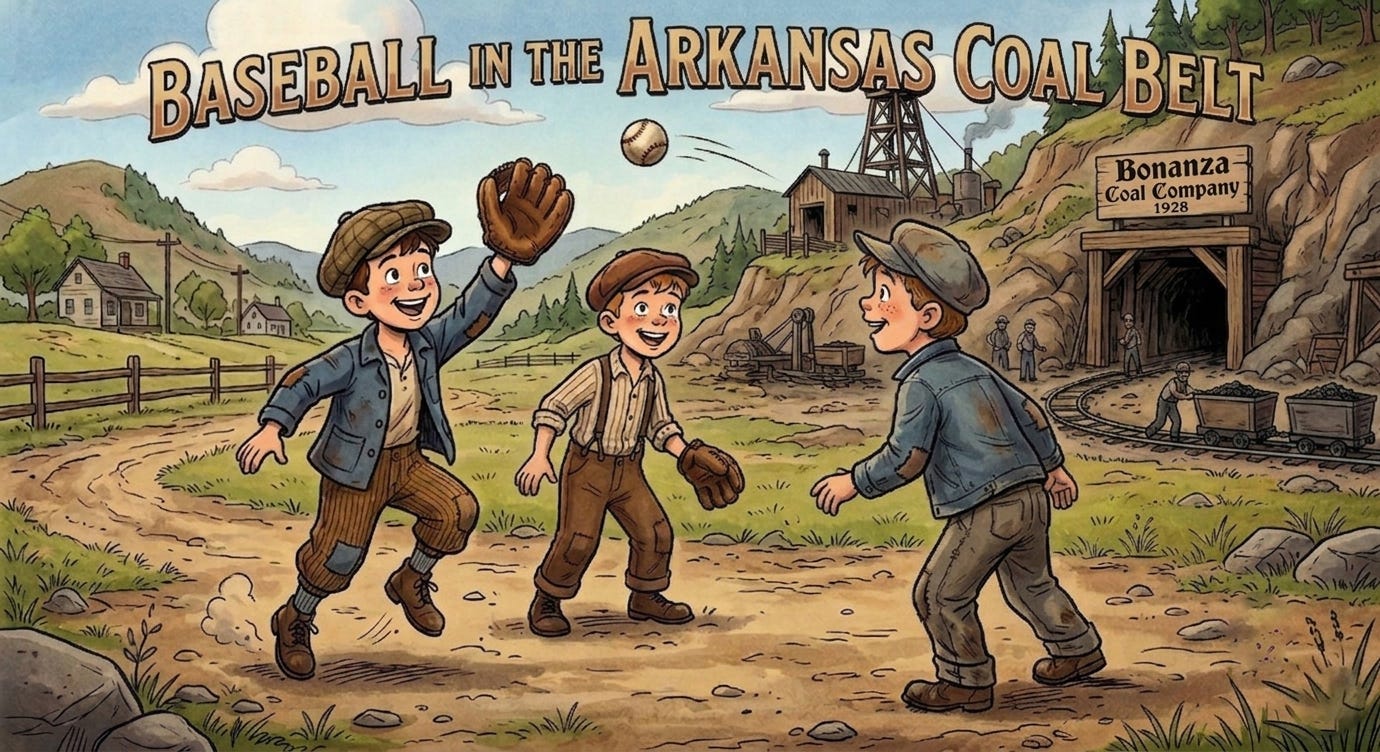
I will see you on July 20, 7 pm, at Farmers Bank in Greenwood: Baseball in the Arkansas Coal Belt.
A Mystery photo, 3Dog is Overlooked, A Monday Story, and a Writer Named George Starts WAR.
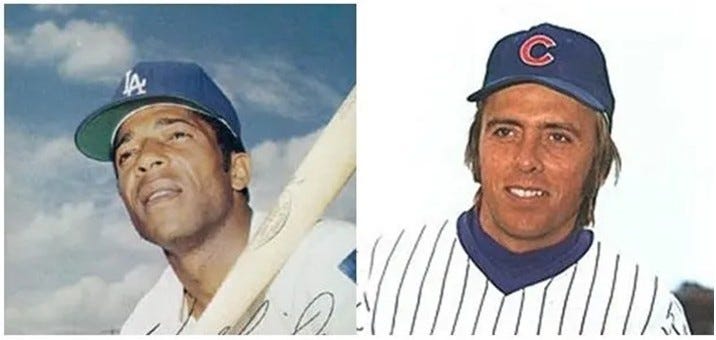
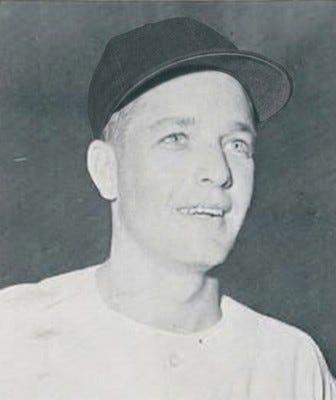
Mystery photo, July 2026
I played in more than 1500 professional games…AND I have a baseball card!
Do you know me?
________________________
A boy named George…
The lost story about a young man’s obsession with evaluating baseball performance goes like this…
A few months after I was born, a historically significant guy named George was born in Holton, Kansas. Holton, a bucolic small town, about the size of my hometown, Ozark, Arkansas, is not the kind of place one might expect to produce the instigator of any kind of WAR. Holton is surrounded by wheat fields about 35 miles north of Topeka, between the Kickapoo Reservation and the Potawatomi Nation Reservation.
It seems baby George grew up with an unrelenting need to evaluate things. He ranked oatmeal below pancakes, and his rubber baseball as his favorite toy. Given his affection for ranking things and the math required to dedicate his life to evaluations, you might think George became a mathematician or an engineer. He did not.
George joined the Army and did not finish a college degree until after his discharge. In contrast to his need to rank and evaluate his world, he received degrees in English and education from the University of Kansas.
At this point, young George did a strange thing. He became a baseball writer. He needed order, but he loved baseball.
At some point in the 1980s, after covering “arguments” and “solutions” about how to objectively evaluate baseball players, George started comparing players to a low baseline in his writings. The fledgling writer’s preliminary work became the foundation for WAR, and George William James became famous, or infamous, for his work in analytics.
After those early attempts to find a way to mitigate arguments that fans really didn’t want to settle, Bill James’ idea morphed into something we now call Wins Above Replacement. No single person or group can actually take the credit (blame) for today’s WAR, but it has become a very popular way to do the impossible: rank baseball players objectively.
Of course, most of the story above is fiction. In an evaluation of its value to baseball literature, my Bill James story would get about a —3.1 WAR, which means almost any writer could have done better.
The modern versions of WAR were later fleshed out over time. I use WAR like toothpaste. I need it, and I use it, but I have no idea what is in it. For those of you who might want to calculate WAR, below is the formula for position players as of July 6, 2026.
This formula, and its accompanying acronyms, are more than you probably want to know about WAR, but it certainly doesn’t keep the average fan from using it if it supports their argument and ignoring WAR if it contradicts their opinion.
The first five factors are compared to the league average, so a value of 0 represents an average player.
bWAR=(Pruns−Aruns)+(Aruns−Rruns)Runs per win

Pruns - The amount of runs a player's batting performance creates compared to a replacement-level player.
Rruns -The baseline amount of runs expected from an average player with the same number of plate appearances.
There you go. Get out your yellow legal pad and pencil.
On June 30, ESPN writer Bradford Doolittle wrote an excellent article in ESPN Online called State of WAR: Why it rules MLB, frustrates fans ... and what’s next. Below is a link to that feature story. I don’t know how long ESPN leaves stories online, but give the link a try.
State of WAR, Bradford Doolittle
___________________________
Another slant on objective evaluations deals with Hall of Fame worthiness. Last week, I went down the rabbit hole that analytics creates in all baseball player evaluations and tried to utilize the work of another baseball sabermetrician, Jay Jaffe. Jaffe has made a living quantifying worthiness for the Baseball Hall of Fame. Like most of the math guys who want to take the fun out of the “eye test” for greatness, Jaffe’s favorite metric is, of course, WAR.
It has become a widely accepted practice in halls of fame that there are three ways to be worthy. One especially vague evaluation recognizes a career that features a period (not specified in length) when the player was historically outstanding at his position. Dizzy Dean and Sandy Koufax are the two most often cited examples.
Another subjective way to be acceptable to voters is to have made a uniquely significant contribution to the game. Buck O’Neil and Alexander Cartwright come to mind immediately.
The most common HOF criteria and the most measurable are career accomplishments and comparative statistics. WAR and Jaffe’s more complex JWAR are examples of statistical and comparative analysis. JWAR amends WAR to take previous inductees into the formula.
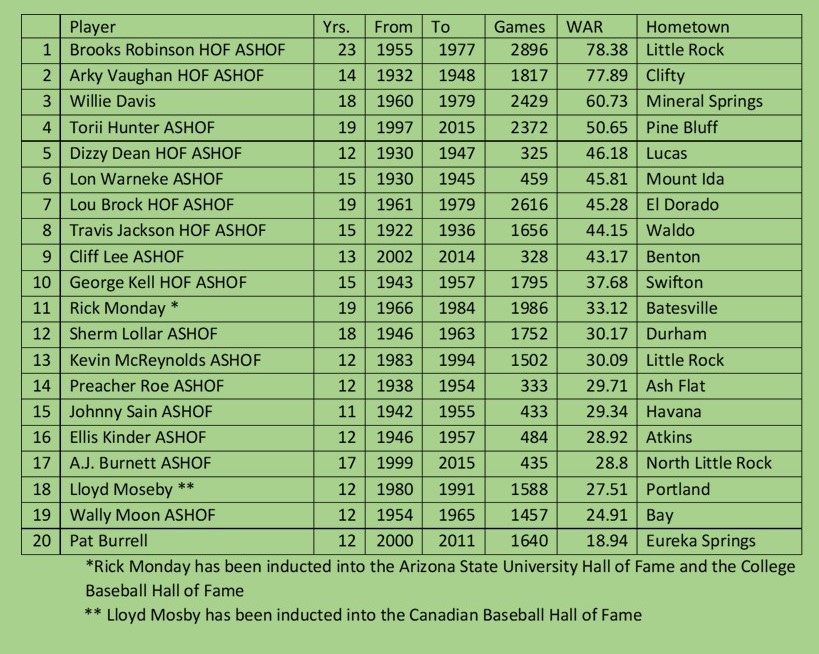
The Arkansas Sports Hall of Fame gets a big check mark for inducting major league baseball players who are highly ranked by career WAR. In the top 20 Arkansas-born major leaguers ranked by career WAR, the ASHOF has inducted 16. One strange case of a statistically deserving player stands out.
Let’s call our non-ASHOF player “3Dog” to refer to his credentials. He is third in career WAR among Arkansas-born big leaguers. 3Dog ranks above Torii Hunter, Dizzy Dean, Lou Brock, Cliff Lee, and George Kell.
Before you shame those of us who are Arkansas Sports Hall of Fame voters for overlooking this great Arkansas-born player, consider the oversight of the Baseball Hall of Fame. The amazing 3Dog NEVER EVEN APPEARED on a Baseball Hall of Fame ballot.
3Dog is Dodger’s star, Willie Davis. If Arkansas gets a pass because Davis lived in Arkansas only a few years as a child before leaving the state for good, the Baseball Hall of Fame can’t be as easily forgiven.
Davis played for several teams, one of which is among the most historically significant franchises in baseball history. He is the Dodgers’ career leader in WAR for position players (59.6), at-bats (7495), runs (1004), hits (2091), total bases (3094), triples (110), and extra-base hits (585). He was in the top 20 in the MVP vote three times in an 18-year career. He was a two-time All-Star, and he has three Gold Glove trophies.
Davis had an unflattering reputation among players, the press, and even his teammates. He is unlikely to ever appear on a Baseball Hall of Fame ballot, and he has an even slimmer chance to be selected for the Arkansas Sports Hall of Fame.
Although Davis and Lou Brock both had excellent careers and moved out of Arkansas to stay as toddlers, the ASHOF inducted Cardinals’ star Brock thirty years ago.
_______________________
An Independence Day Story of a Monday in Arkansas Baseball History
Rick Monday was born into a baseball family in Batesville, Arkansas, in November 1945. The Monday name can be found in semi-pro box scores throughout the first half of the 20th century. His family moved to California when he was a child, and Rick Monday is far from a celebrated Arkansas major leaguer.
Monday played in almost 2,000 games, sixth in career games among Arkansans. He is fourth in home runs (241), sixth in runs scored, and his .804 OPS is fifth among players with 2,000+ at-bats.
Monday was a two-time All-Star selection whose exceptional arm and speed made him a fixture in centerfield for 19 years. He led his league in double plays by a center fielder twice, and he was in the top five in five seasons.
Monday is 11th in career WAR among major leaguers born in Arkansas, above Arkansas Sports Hall of Famers Kevin McReynolds, Sherm Lollar, Preacher Roe, Johnny Sain, Ellis Kinder, A. J. Burnett, and Wally Moon. He is very unlikely to ever be selected for the ASHOF. The Rick Monday story is generally forgotten in Arkansas baseball history.
BUT
On April 25, 1976, during a routine Sunday afternoon game between the Chicago Cubs and the Los Angeles Dodgers, the world of sports witnessed a Rick Monday moment that transcended the box score. In the bottom of the fourth inning at Dodger Stadium, Rick Monday, the Cubs’ center fielder, made what many consider the greatest “save” in baseball history—not with a glove, but with a display of instinctive patriotism.
The Incident in the Outfield
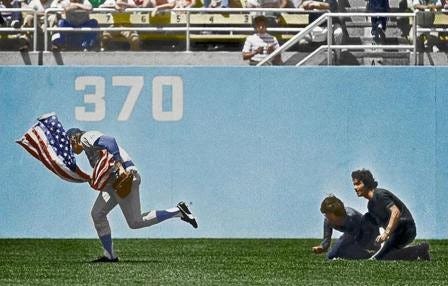
Two protesters, a father and his 11-year-old son, jumped the left-field fence and sprinted toward shallow center field. As they knelt on the grass, they unfurled an American flag and began dousing it with lighter fluid. Monday, who had served six years in the Marine Corps Reserves, initially thought they were just intruders looking for a handshake. However, once he caught the scent of the accelerant and saw a match being struck, his military training and personal convictions took over.
Monday did not hesitate. He charged toward the pair and, in one fluid motion, snatched the lighter-fluid-soaked flag just as the protesters were attempting to ignite it. He didn’t break stride, carrying the flag to the safety of the Dodgers’ dugout. The stadium, previously filled with the typical murmur of a mid-inning break, erupted into a thunderous, spontaneous standing ovation.
The reaction was immediate and profound. As Monday returned to his position, the stadium organist began playing “God Bless America,” and the crowd of over 25,000 joined in a heartfelt chorus. The Dodger Stadium message board famously flashed the words: “RICK MONDAY... YOU MADE A GREAT PLAY.”
Rick Monday still possesses that flag, which was presented to him by the Dodgers organization a month after the event. He has turned down million-dollar offers for his souvenir.
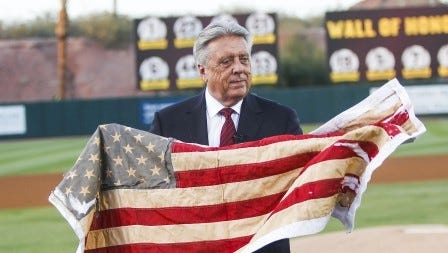
While Monday enjoyed a distinguished 19-year career as a two-time All-Star, he remains most beloved for those 30 seconds in center field when he decided that some things are too sacred to watch burn.
______________________
Thanks for your support. Backroads and Ballplayer Weekly is an example of OUR shared work to save the lost history of Arkansas baseball.
If you do not want to miss these posts, you can subscribe or save the address of the Backroads and Ballplayers Facebook Page. Instructions below:
A Subscription sends these weekly posts to your mailbox. There is no charge for the subscription or the Backroads and Ballplayers Weekly.
If you don’t want to subscribe, you can find the weekly posts on Monday evenings at Backroads and Ballplayers on Facebook. SAVE THE LINK
_________________________
THANKS!