
Backroads and Ballplayers #156
Stories of the famous and not-so-famous men and women from a time when baseball was “Arkansas’ Game.” Backroads and Ballplayers Weekly is always free and short enough to finish in one cup of coffee.

Current Subscribers: 324
If you do not want to miss these posts, you can subscribe or save the address of the Backroads and Ballplayers Facebook Page. Instructions below:
A Subscription sends these weekly posts to your mailbox. There is no charge for the subscription or the Backroads and Ballplayers Weekly.
If you don’t want to subscribe, you can find the weekly posts on Monday evenings at Backroads and Ballplayers on Facebook. SAVE THE LINK
Annual College World Series Vacation Week II: Omaha! and WWII Revisited
____________________
College World Series
Welcome to what is now called MCWS Week!
The expected news: The SEC has five teams in Omaha.
The unexpected news: LSU, Arkansas, Vanderbilt, Mississippi State, Texas A&M, and Florida are watching from home. As an ex-coach, I have a theory about why the five SEC teams still in the tournament are packing for Omaha, while some of the big names in college baseball are recruiting.
Grab a pencil, this is a big take…THEY HAVE BETTER PLAYERS! Helfrick might have to DH in Georgia, and he may be a first-round draftee. My picks: Texas and Georgia in that order. They open with each other! Is the winner the National Champion? What do you think?
____________________
Strange Things Happened in World War II
June 26, 1944
My friend Dr. Tom DeBlack refuses to admit that he LOVES baseball, not realizing that an intellectual game like baseball is good for his resume. A “Professor Emeritus” should promote the idea that he appreciates a game of strategy and higher-order thinking skills, rather than games based on brute force. He has a clandestine email following, to which he sends videos about baseball history recorded by some fast-talking narrator who must be on the clock.
Although Dr. DeBlack obviously does not want his affection for baseball to become public, I feel like I should credit him for the video below about a strange baseball game played in 1944.
The game came 20 days after the Allied landing at Normandy Beach. The event was created as a way to sell war bonds and featured one game and three teams. The Dodgers, Giants, and Yankees played each other in a three-way exhibition game at the Polo Grounds on June 26. Admission was $25, and the promotion was successful, at least in terms of fundraising.
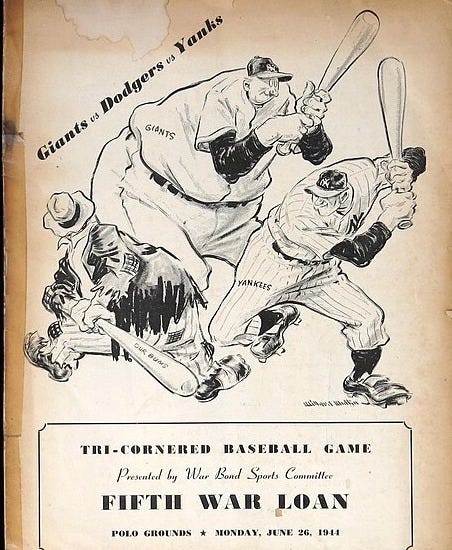
After listening to the frantic narrator, return by clicking on the Backroads and Ballplayers tab. Be sure to allow sound… Link
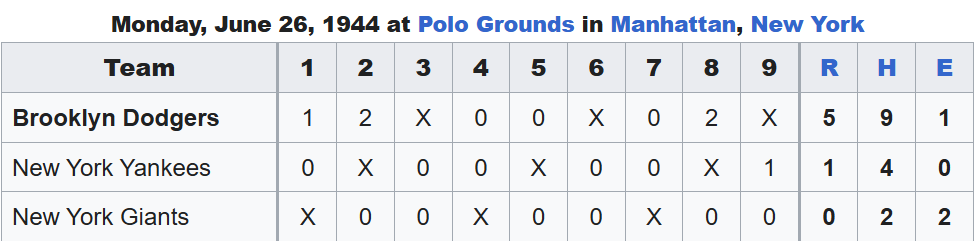
___________________
Jittery Joe Revisited
On Sunday, September 6, 1942, at Pittsburgh’s Forbes Field, the Cubs and Pirates played a game that meant nothing. The Pirates were headed for fifth place in the National League standings, and the Cubs would finish one spot lower. America was embroiled in a war overseas, and many major leaguers were already in the military. Teams were getting desperate for pitching. So much so that on that day, Cubs’ manager, Jimmie Wilson, decided to take a look at the unusual rookie the Cubs had added a few days earlier. Behind 3—0 and going nowhere in the standings, perhaps he was more curious than hopeful about this strange-looking fellow in his bullpen.
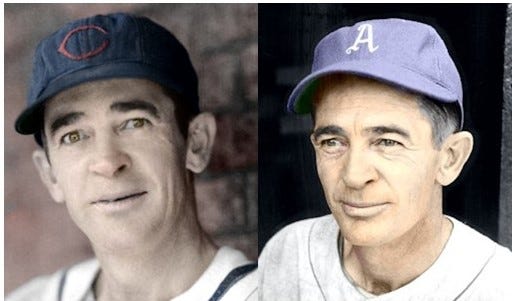
They called him “Jittery Joe,” and his appearance did not exactly strike fear in opposing hitters. The rookie pitcher was maybe 5’ 9” and on a good day weighed about 135 lbs. His uniform hung from a wiry frame like a child in an adult’s shirt, and his country stride walking to the mound was almost comical. Jittery Joe had been dominating for Tulsa in the Texas League in the 1942 season, but it took considerable imagination and some apathy for a major league team to give him a shot. Incidentally, Jittery Joe was 37 years old, and he had pitched more than 3,000 innings over 16 seasons to earn this chance.
Jonas Arthur Berry was born December 16, 1904, in Huntsville, Arkansas, in the heart of the Ozark Mountains. He was the eighth of nine children who grew up on War Eagle Creek in Madison County. His father, Jonas “Joan” Berry, was a part-time farmer and occasional Sheriff of Madison County, having been elected to three terms over forty years.
Known locally as Joe, Berry was a semi-pro pitcher of some notoriety in the Ozarks when he got his chance to give professional baseball a try. He made his pro debut in 1927, pitching in Mississippi for teams in the Class D Cotton States League. He would remain with various franchises in the CSL for six seasons and post 85 victories during his stay in the virtual obscurity of baseball’s lowest minor leagues.
Berry was 28 years old before he advanced to Joplin in the Class C Western Association in 1933. He was the second-oldest player on the Joplin team, which was not a good sign for a pitcher on the way up.
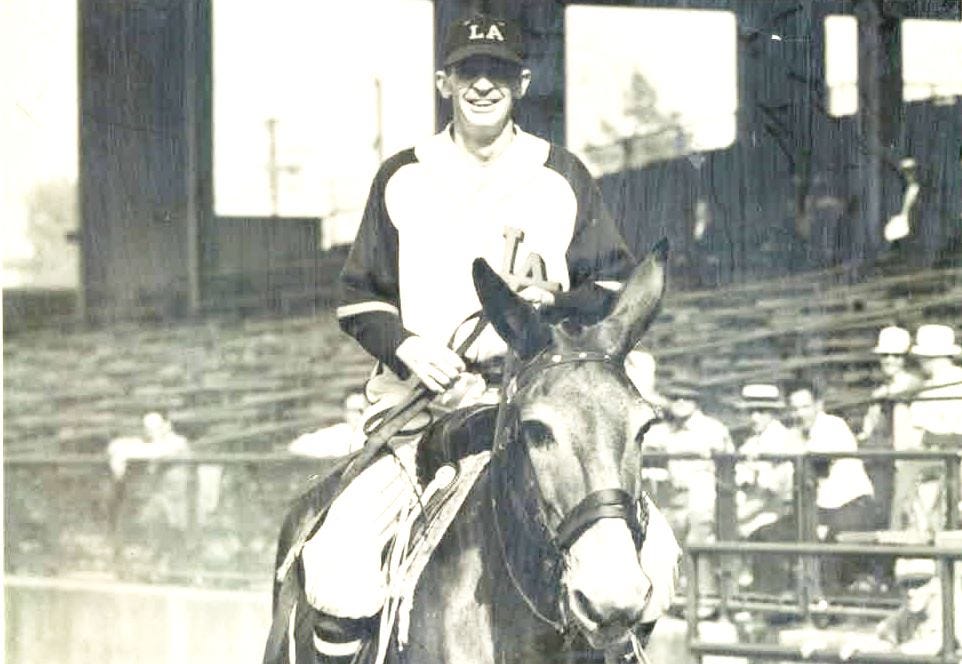
After three successful years in the Western Association, Berry got the promotion that changed his life in the winter of 1935, when the Cubs optioned him to the Los Angeles Angels of the prestigious Pacific Coast League. Big city newspapers covered PCL games daily, and sportswriters soon started searching for adjectives to describe the Angels’ unlikely-looking pitcher from the Ozark Mountains.
Always painfully slow-working, Berry became even more deliberate as his success began to depend more on deception than speed. He stepped off the mound, rubbed down the ball, tugged at his oversized uniform, and shook off the sign. Making the hitter wait was an effective new weapon. The term jittery seemed to fit him well, and by September, most sports page stories about Joe Berry used his new moniker, “Jittery Joe.” Other new adjectives were also attached to Berry in the PCL. Many of these descriptions, like “sensational” and “outstanding,” had seldom been used to describe relief pitching before.
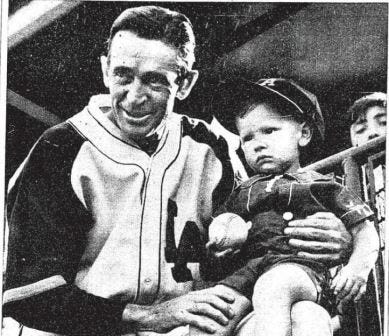
In 1942, despite six good years in Los Angeles, the Cubs moved 37-year-old Berry down to Tulsa, a Class A team in the Texas League, where he had another outstanding season. With hundreds of major league pitchers called to active duty, the Cubs were now so desperate for pitching help that in September, Jittery Joe Berry got the call to the major leagues.
The game Jittery Joe had looked forward to for 17 years did not go well. After a routine first out, Berry gave up a double, a triple, two singles, and a walk. When the Pirates finally went down in the inning, Berry had faced eight batters, allowed five to reach base, and given up two runs. A week later, he gave up two more runs in an inning’s work. He did not look like a major league pitcher, and he had not done anything to dispel that image.
The Cubs saw nothing of value in Jittery Joe and released him after the season. He was nearing his 40th birthday, but there was no quit in Joe Berry. Back in the minors with Milwaukee, he won 18 games in 1943. Berry looked good enough to Philadelphia Manager Connie Mack to get another shot at the majors. Perhaps the old Philly boss was desperate for pitching, or perhaps he had a different perspective on age, since he had just turned 81.
The 1944 Athletics finished a distant fifth, but Joe Berry was the best relief pitcher in the American League. He was second in the league in pitching appearances and the league leader in games finished and saves. Although finishing games and carrying the designation of “closer” had not gained the prestige of that role in today’s game, Joe Berry was an overnight star in Philadelphia.
In 1945, Berry picked up right where he left off in 1944. He led the league in games pitched and games finished. Despite the addition of a promising rookie third baseman from Swifton, Arkansas, named George Kell, the A’s were a hapless last-place club, with only one pitcher with more wins than losses, Jittery Joe Berry.
Jittery Joe’s size, age, and everyman appearance made him a Philadelphia hero and a national phenomenon. America needed “feel-good” stories, and it was easy to enjoy the success of a 40-year-old hillbilly humbling the big guys up in Philly. Jittery Joe thrived on an assortment of deceptively slow stuff. Along with a screwball and an assortment of curves, some say he threw an occasional illegal spitball. If indeed he threw the spitter, he used the phantom spitball much more often. Along with his jittery antics, Berry would appear to go to his mouth, then to the ball, in an attempt to convince the hitter the spitball was coming. After those obvious tip-offs, it never did.
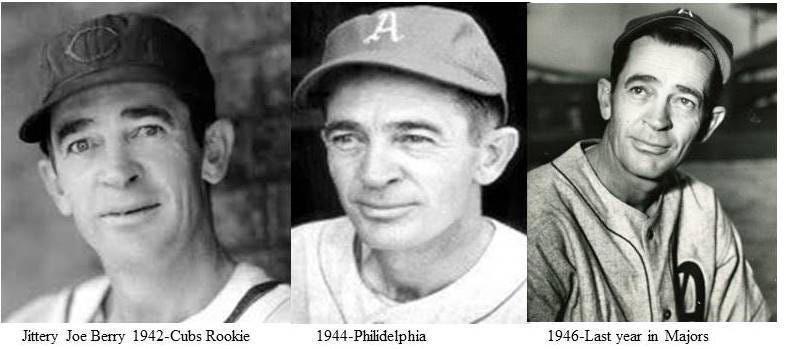
Berry had one more year in the majors in 1946, but with the regulars back from the war, there was no place in the majors for 41-year-old Jittery Joe. He would continue to pitch in the minors for five more summers. He worked in more than 130 games after his major league career ended, and his ERA for those seasons was a very respectable 2.93. He retired after the 1951 season at the age of 46.
A look at Jittery Joe Berry’s career gains some perspective in relation to 25 years of baseball’s legendary stars. When Berry broke into baseball in 1927, Babe Ruth was in the process of hitting 60 home runs for the legendary “Murderers Row” Yankee lineup that also included a 24-year-old kid named Gehrig, who drove in 173 runs. Mickey Mantle, Willie Mays, and Hank Aaron had not been born.
Berry pitched against Bill Dickey, Joe DiMaggio, and Ted Williams. He was almost twice the age of fellow Arkansan George Kell when they were teammates in 1944. He witnessed history from 60 feet away, pitching to Jackie Robinson in Canada in 1946, and when Berry retired in 1951, Mantle and Mays were rookies taking New York by storm. Ruth and Gehrig were deceased.
Jittery Joe Berry pitched in 936 games in 24 summers of professional baseball. He played on teams in 20 cities and towns across the United States, from Laurel, Mississippi, to Los Angeles, California, and he has the rare distinction of having played pro baseball in four decades from the 1920s to the 1950s. Jonas Berry lost his life in a traffic accident in Anaheim, California, on September 27, 1958, at age 54. He is buried in Huntsville, Arkansas, under a gravestone inscribed “Jittery Joe Berry.”
__________________________