
Backroads and Ballplayers #142
Stories of the famous and not-so-famous men and women from a time when baseball was “Arkansas’ Game.” Backroads and Ballplayers Weekly is always free and short enough to finish in one cup of coffee.

How about the Hogs, SABR Meeting Recap, and Lost Stories of Arkansas Characters of the Game…
If you do not want to miss these posts, you can subscribe or save the address to the Backroads and Ballplayers Facebook Page. Instructions below:
A Subscription sends these weekly posts to your mailbox. There is no charge for the subscription or the Backroads and Ballplayers Weekly.
If you don’t want to subscribe, you can find the weekly posts on Monday evenings at Backroads and Ballplayers on Facebook. SAVE THE LINK
If you receive this post by email on a desktop, you may prefer the desktop version.
____________________________________
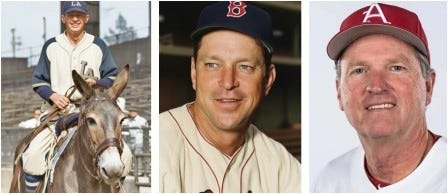
MARCH! - College baseball is in full swing, the weather is better, and TV has returned to new episodes of our favorites. I have “Loved Raymond” about as much as I can tolerate.
Historically, at this time, I write an optimistic little cautionary piece titled something like, “How about those Hogs! So, in keeping with that theme…
How about those Hogs, with a question mark rather than an exclamation point?
I am an unapologetic Dave Van Horn guy. There are a lot of puzzle pieces scattered around the table as the Diamond Hogs move toward the last weekend before their SEC gauntlet. I have seen Van Horn and his staff make a good season with groups with less “February promise.” I see several encouraging things, and I have some concerns.
We seem to have a really good middle of the lineup. Don’t expect them to drive in an important run from second with an opposite-field single, but clutch homers that win games will be a frequent event. That is the way today’s young players are taught, and it seems to be the state of the game.
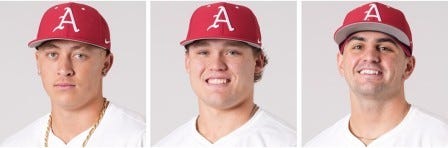
We currently have some “outs” at the bottom of the order. They will get better, but SEC pitchers will also be better. The decision-makers seem to be committed to the guys we have in the eight and nine spots, and the time for experimentation has passed.
AND yes, we have some talented pitchers, maybe more depth than in recent years, but some questions. What do you think?
In June, the 2026 Razorback baseball team will be described as:
Disappointing, Okay, Pretty Good, Very Good, A Top 10 Team, Omaha Bound
Click here: Please make a choice in this anonymous survey!
_______________________________
Speaking of the Razorbacks…
SABR Meeting Review, Saturday, February 28, 2026
The Robinson-Kell Chapter met on Saturday in Bryant. The chapter’s guest speaker, former Razorback pitcher Boyd Goodner, sat down on a stool and said he planned to talk for 15 minutes. An hour and a half later, our president, Madison McEntire, had to rescue him.
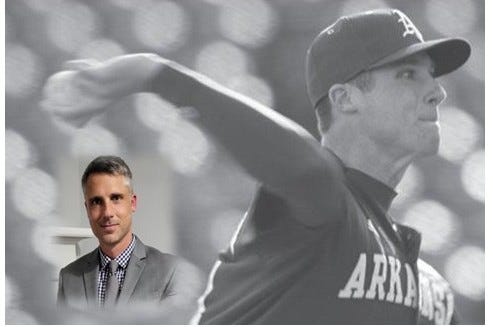
Although Goodner was a forty-something in a group of guys who didn’t go to work today, he is a kindred spirit. He took our questions, chatted, shared stories, and sometimes joined in our concerns about the “state of the game. He was exceptional. Perhaps late for lunch, but exceptional.
Regulars, Chase Hartsell (Rickey Henderson), Michael Eggleton /Jamin Ross (The Search for Missouri Pacific Field), and Johnny Mullens (Don Kessinger) presented excellent research projects on Arkansas baseball history.
Make a note to attend the next meeting. Guests are always welcome.
Richard McKeown of the Saline Courier attended the meeting. McKeown wrote an excellent piece about the Robinson-Kell Chapter in the Saline Courier on February 21. Read below: A Not So Trivial Pursuit: Baseball devotees set for semi-annual gathering
_________________________________
Lost Stories of Two Characters of Our Game
Nicknames are part of baseball, and our state has its share of colorful alternative identities. Some came with them from childhood, others from their physical appearance, and occasionally, the nicknames were bestowed on them due to some unique personality trait.
There have been dozens of big leaguers called “Slim,” “Slats,” and “Skinny,” and a few tagged as “Fatty,” “Runt,” and “Pudge.” Players simply called “Lefty” number in the hundreds, but “Righty” seldom sticks as a nickname. Dizzy Dean was not the only major leaguer with an alternate name based on some erratic behavior. There have actually been several other “dizzy” big leaguers, and a 1970s pitcher known for his unpredictability was given the more contemporary sobriquet, “Spaceman.”
________________________
Senior Citizens
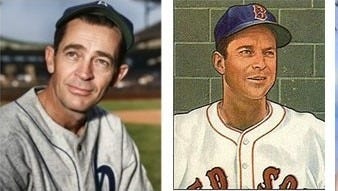
They Called Him Jittery Joe,
Jonas Arthur Berry was born in Madison County, Arkansas, in 1904. He made his pro baseball debut in 1927, pitching for the Laurel Lumberjacks and Gulfport Tarpons in the Cotton States League. Fifteen years and about 200 appearances later, he finally earned two forgettable innings for the Chicago Cubs in 1942.
Although his ERA in his disastrous two-game debut was 18.00, he was back in the show in 1944. It may have been desperation due to the number of pro baseball players in military service that got him back to the majors, but in his second big league stint, Jonas Berry became a star for Connie Mack’s Philadelphia A’s and one of the most popular stories in baseball.
The press described him as slight, slow-working, and fidgety. He might have weighed 140 lbs., and his uniform was about two sizes too large for his small frame. He stepped off the mound, rubbed down the ball, tugged at his oversized uniform, and shook off the sign. Making the hitter wait was an effective new weapon.
The term “jittery” seemed to fit him well, and by September, most sports page stories about Joe Berry used his new moniker, “Jittery Joe.” Other new adjectives were also attached to Berry, describing him as “sensational” and “outstanding,” words which had seldom been used to describe relief pitching before.
Sure, wartime had diluted the number and quality of big league pitching, but 40-something Joe Berry led the American League in Saves in 1944 and Games Finished in 1945.
As expected, his success diminished as regulars returned from the war, but he found a place to play in pro baseball for five more seasons. His last job came in an invitation from the Corpus Christi Aces late in 1951. The Aces needed some pitching depth entering the home stretch of the season. Forty-six-year-old Jittery Joe was the winning pitcher in Corpus Christi’s last regular-season game.
When Joe Berry made his pro baseball debut in 1927, Babe Ruth and Lou Gehrig were part of the Yankees’ legendary “Murderers Row.” Mickey Mantle and Willie Mays were yet to be born. When Berry pitched his last game at Corpus Christi in 1951, Mantle and Mays were in New York, and Ruth and Gehrig were deceased.
More on Jittery Joe Berry in Only in Arkansas
________________________
Old Folks and “100”
Ellis Raymond Kinder was born on July 26, 1914, in the Atkins Bottoms, near a bend in Highway 105 once called Wilson, Arkansas. Brooks Calbert Robinson (Sr.) was born in the same year, about a mile down the road. After the flood of 1927 and the Great Depression, the Kinders survived in Wilson picking cotton, but with no such prospects, Brooks Calbert Robinson Jr’s father moved with his widowed mother to Little Rock.
Kinder was picking cotton and working at a sawmill when he decided to take a chance on pro baseball in 1939. While it was a risky choice, it looked better than backbreaking work at the mill and dragging a cotton sack through the Atkins Bottoms. It would take five minor league seasons and a tour of duty in the Navy before Kinder finally reached the major leagues.
Kinder was 31 years old when he joined the St. Louis Browns in 1946. Eight years older than the average rookie, his teammates called him “Old Folks.” Kinder quickly became the ace of the Boston staff, despite little attention to team rules or normal training conventions. He had time on his hands, money in his pocket, and little experience with either. He was consistent, with equal celebrations for wins and losses. At the occasion of his funeral, his wife, Hazel, lamented, “Ellis, bless his heart, sure knew how to have a good time.”
He won 23 games as the Boston Red Sox’s top starting pitcher in 1949, but despite his lack of formal education, he realized that at age 34, he was in the autumn of his baseball career. When he had the chance to transition into a relief pitcher, he readily agreed. Relief pitching was a new specialty in big league baseball, and a crafty country boy from Arkansas was about to become the best relief pitcher in the American League. He started 23 games in 1950, but only 14 in the remaining seven years of his career.
In 1951, his first year as a full-time reliever, Kinder won 11 games and lost only two in 63 appearances. He retired in 1959 at the age of 42. Although Saves were not part of the pitching records until 1969, Kinder was retroactively credited with 104 lifetime saves.
Ellis Kinder pitched in almost 500 major league games, all after the age of 31. Although his formal education ended in elementary school, he is regarded as one of the craftiest pitchers in baseball history. Ellis Kinder remains the only Arkansas-born major league pitcher with 100 Wins (102) and 100 Saves (104).
More on Ellis Kinder in Only in Arkansas
________________________