Backroads and Ballplayers #141
Stories of the famous and not-so-famous men and women from a time when baseball was “Arkansas’ Game.” Backroads and Ballplayers Weekly is always free and short enough to finish in one cup of coffee.

If you do not want to miss these posts, you can subscribe or save the address to the Backroads and Ballplayers Facebook Page. Instructions below:
A Subscription sends these weekly posts to your mailbox. There is no charge for the subscription or the Backroads and Ballplayers Weekly.
If you don’t want to subscribe, you can find the weekly posts on Monday evenings at Backroads and Ballplayers on Facebook. SAVE THE LINK
If you receive this post by email on a desktop, you may prefer the desktop version
_________________________
Town Team of the Month, Lost Stories: UofO’s Chuck Daniel’s Role in Ray Winder’s Finest Hour, and a “Rediscovered” AIC Title for the Eagles
February Town Team of the Month: Nashville Cubs
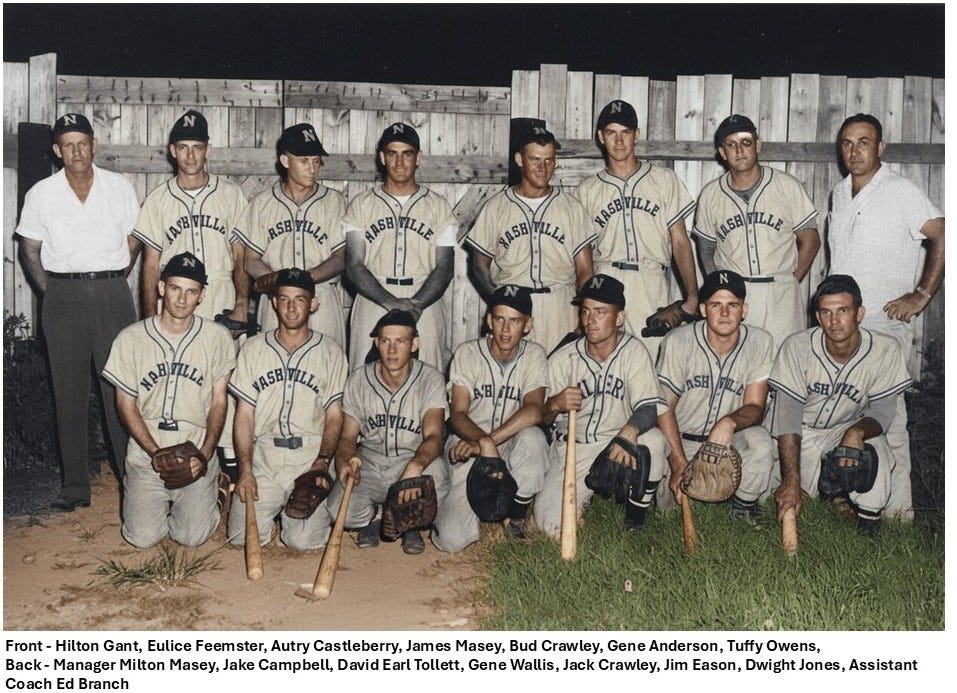
Nashville, Arkansas, is a sports town, perhaps THE high school sports town of its size in Arkansas. The Nashville Scrappers have won dozens of state titles in both boys and girls sports, and almost everyone in town will be happy to share their connection to one or more of the legendary Scrappers’ teams.
Honor Roll of Nashville Scrappers State Championships
Although Nashville is not exactly on the most traveled routes through Arkansas, local folks will remind visitors that Bentonville may have been the location of Sam Walton’s first store, but the first Dillard’s was opened on Main Street in Nashville, Arkansas, in 1938.
Less prominent among the noteworthy events in the history of the Howard County town is the almost forgotten story of the Nashville Cubs. In September 1956, the Cubs were the biggest story in town and featured prominently in the major state newspapers. In a time when baseball was Arkansas Game, men’s semi-pro state titles were the most prestigious baseball championships in the state.
Arkansas actually had two state semi-pro championships in the 1950s. In 1956, the Jonesboro Star Chiefs won the National Baseball Congress (NBC) title in July, before the Arkansas Baseball Congress Championship (ABC) held its championship tournament in September.
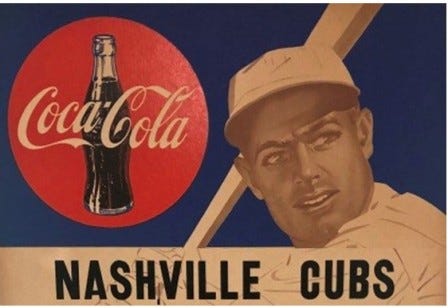
The Cubs played their regular-season games in the Southwest Arkansas Semi-pro League and advanced to the ABC Tournament in Little Rock the first week of September. A local community leader named Milton Masey had established the Cubs in 1951, and the “town team” remained a summertime attraction in Nashville until the popularity of slow-pitch softball moved semi-pro baseball to an almost forgotten place in Arkansas baseball history.
Obviously, few Howard County residents remain with eyewitness memories of the State ABC tournament played at Lamar Porter Field in Little Rock. Both the Arkansas Gazette and the Arkansas Democrat made the championship a feature story. The state semi-pro championship was the pinnacle of baseball titles in 1956.
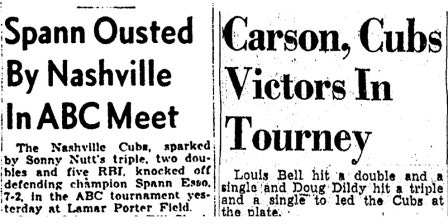
The Cubs eliminated defending champion Spann’s Esso in their first tournament game and fought through the double-elimination tourney to reach the important winners’ bracket final. A win over Carson’s Service Station would mean the team that met Nashville in the finals would have to defeat the Cubs twice. The pivotal game would be the first of two comeback victories that headlined the Arkansas sports pages.
Trailing 4-0 going into the last two innings, the Cubs scored two runs in the 8th inning and three in the ninth to assure themselves of a place in the championship game. Of course, in a storybook year for Nashville baseball, the ABC tournament finals was also a classic that featured a rematch with the tough Carson squad.
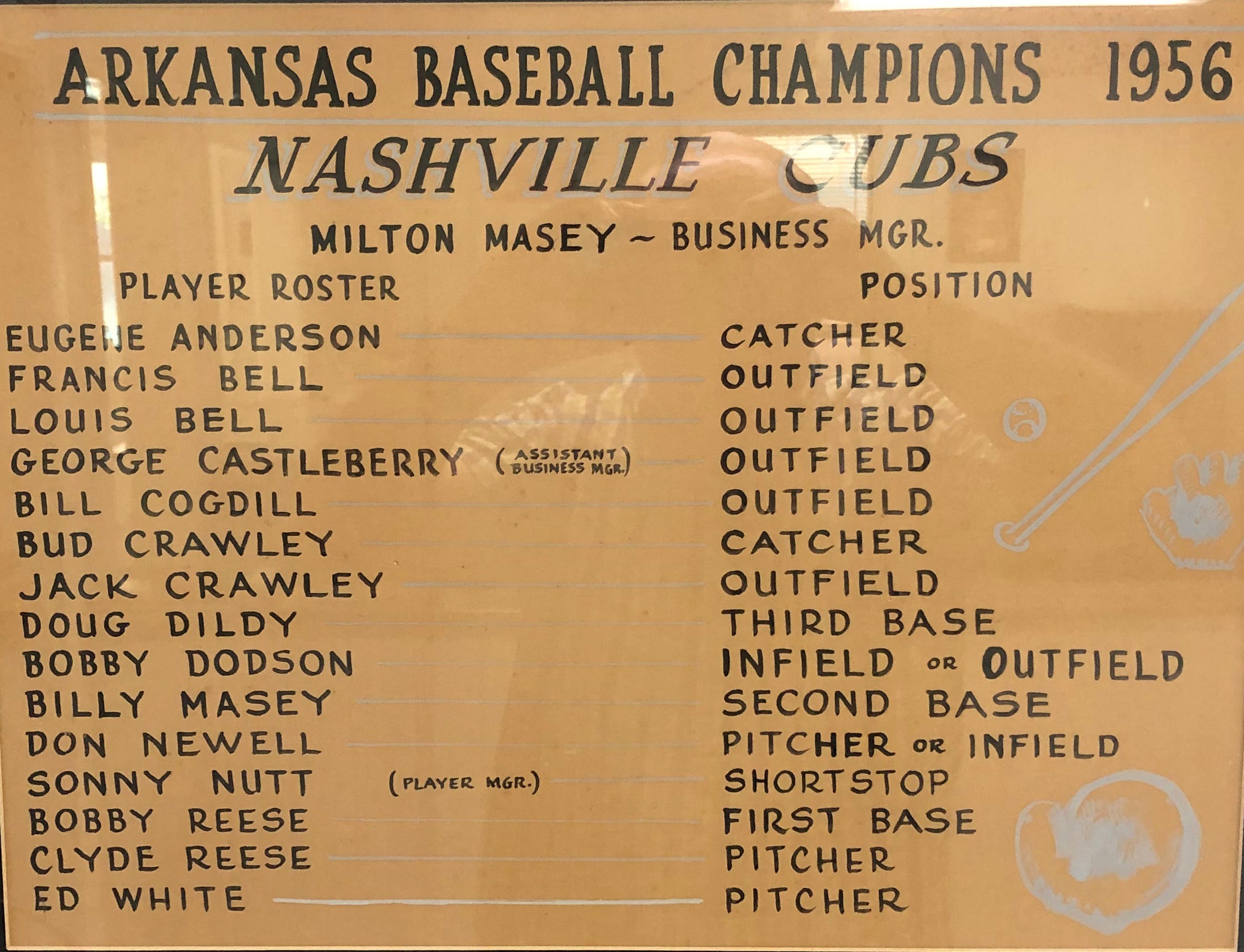
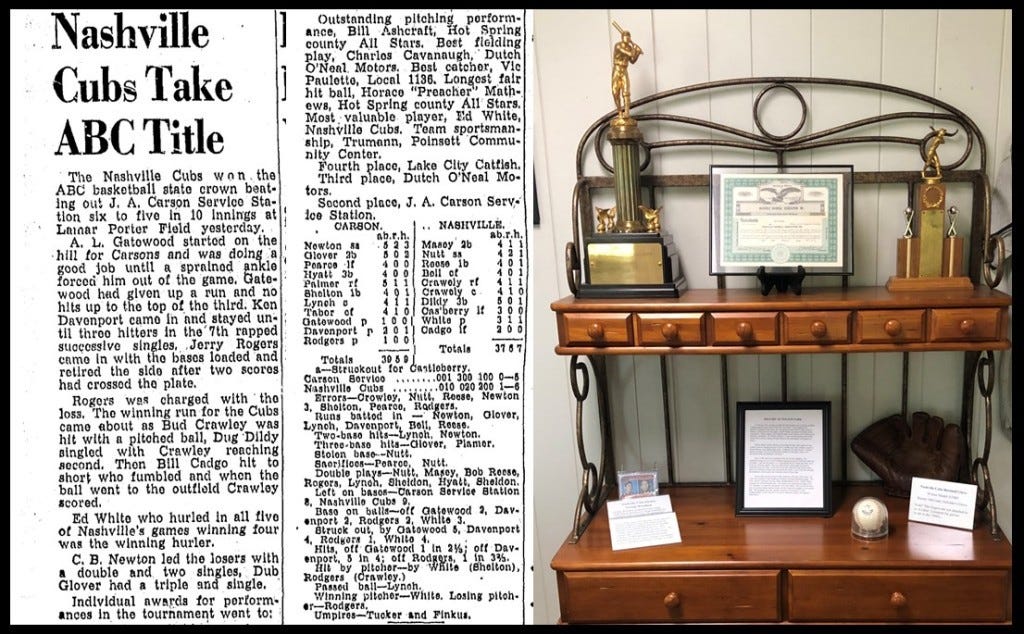
After trailing Carson Service Station going into the bottom of the seventh inning, the Cubs rallied to tie the game that eventually went into extra innings. In the bottom of the 10th, with the two rivals tied at five, a mishandled ground ball trickled into left field and scored the run that made the resilient Cubs the Arkansas State Champions. Nashville pitcher Ed White, who had been the winning pitcher in five tournament wins, was named the ABC Championship’s Most Valuable Player.
______________________________
Last week I wrote about my visit to the beautiful sports complex at the University of the Ozarks in Clarksville. Lonnie Qualls Field is part of the Wilson Sports Complex on campus. The complex is also home to the UofO soccer teams and the women’s softball team. You will not only be surprised by the facilities, but also the quality of play in Division III.
The visit to the rejuvenated campus reminded me of the rich sports tradition of the UofO Eagles and the College of the Ozarks Mountaineers. It also reminded me of the happy ending to the story of CofO pitcher Chuck Daniels and his role in one of the most amazing stories in Arkansas Travelers’ history.
In 1960, Ray Winder somehow put together a team three weeks before Opening Day. The amazing collection of unwanted players would receive national attention in September by winning the Southern Association Playoff. The Sporting News would call the Travs’ season, “one of the most spectacular diamond stories of the year.”
The Lost Story of the UofO’s Chuck Daniel’s role in Ray Winder’s Finest Hour
The life story of Ray Winder is woven into the history of the Little Rock Travelers. Winder began with the Travelers in 1915 as a troubleshooter for a franchise that had failed in 1910. He helped build the team that won the city’s first pennant in 1920 and served in various critical roles for 50+ years. Perhaps his most amazing single accomplishment was the rebuilding of the 1960 championship team.
After selling their financially troubled franchise in 1958 and spending 1959 without a team, Little Rock accepted the challenge of a late summer offer to bring minor league baseball back to Little Rock. With just weeks remaining before the 1960 season began, Arkansas secured a new franchise by purchasing the New Orleans team in the Southern Association. Ray Winder organized the city in a unified effort to raise funds and refresh the ballpark, while he scoured the minor leagues for available players.
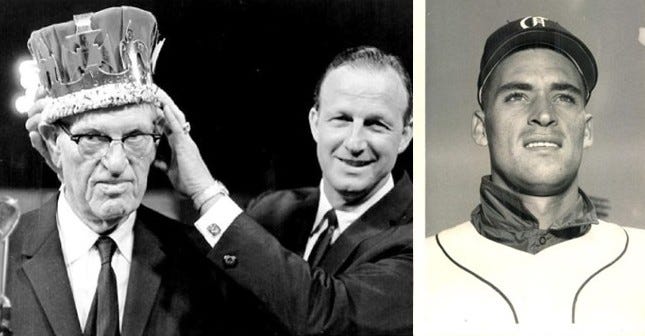
Arkansas had a franchise, a temporary board of directors, and Ray Winder as an advisor. Now, they only needed players, a manager, a general manager, and an overhaul of their home park. Work on a neglected Travelers Field began immediately, and Ray Winder caught a train to look for players. Opening day was 19 days away.
One of Winder’s most significant “finds” was a county boy from the Fourche River Valley who had been a pitching star at the College of the Ozarks. Charles Edward Daniel was packing his gear and giving up on baseball when Winder found him in Victoria, Texas. Winder’s sales pitch was simple. Daniel had been a major-league prospect before chronic arm problems ended his big-league career after one game. Going home for Daniel meant Johnson County, Arkansas, and since he was headed that way, why not give the game one last try with the Little Rock Travelers?
For most of the season, the Travs operated on a precipice between postseason play and elimination from the Southern Association playoffs. As July came to a close, Chuck Daniel was an unremarkable emergency starter and relief pitcher with a 5–4 record and an ERA greater than 4.00. That tenuous situation changed one hot summer evening in August and became the fairy-tale saga of the 1960 Little Rock Travelers with Charles Daniel as a leading character.
August 1 was Shrine Night, and the fourth-place Travelers were in danger of missing the Southern Association playoffs. Daniel, the starting pitcher for the Travs that sweltering summer night, had given up eight home runs in his last eight innings on the mound. Somehow, in the movie-script story typical of the Travelers’ season, Chuck Daniel found the form that had made him a major league prospect five years previous. He pitched a complete game in the pivotal win over Birmingham. Shrine Night 1960 would be a precursor to one of the most exciting finishes in franchise history.
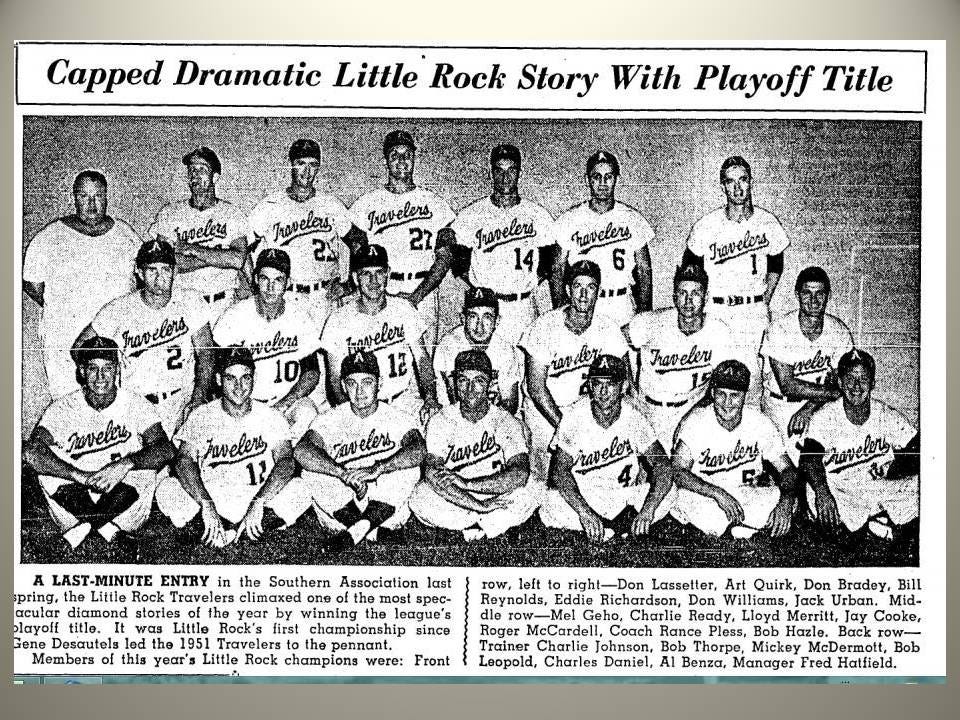
Four days later, Daniel pitched a perfect 9th in relief, and on August 7, he recorded another complete-game victory, a three-hit shutout masterpiece over Chattanooga. Chuck Daniel was back. Daniel would win five games in the last month of the season. The Travelers not only made the playoffs but also won the 1960 Governor’s Cup as Southern Association Champions. The castoffs were the toast of the town, and the Travs led the league in attendance.
Daniel would return in 1961 to lead the Travs in games started, victories, and innings pitched. He retired for good at the end of the season after his second chance for success in his home state, creating a happy ending to the Chuck Daniel story.
________________________
Thoughts on AIC Records and Rediscovery of an Ozarks AIC Baseball Title
I use the AIC Record Book regularly. This week, I found an error that is NOT the fault of the men and women who arranged the agreement with the Arkansas Sports Hall of Fame to link these records to the ASHOF website. The mistake is simply a clerical error from many years ago. (1983?)
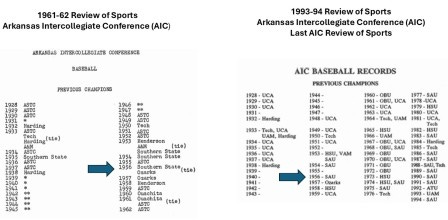
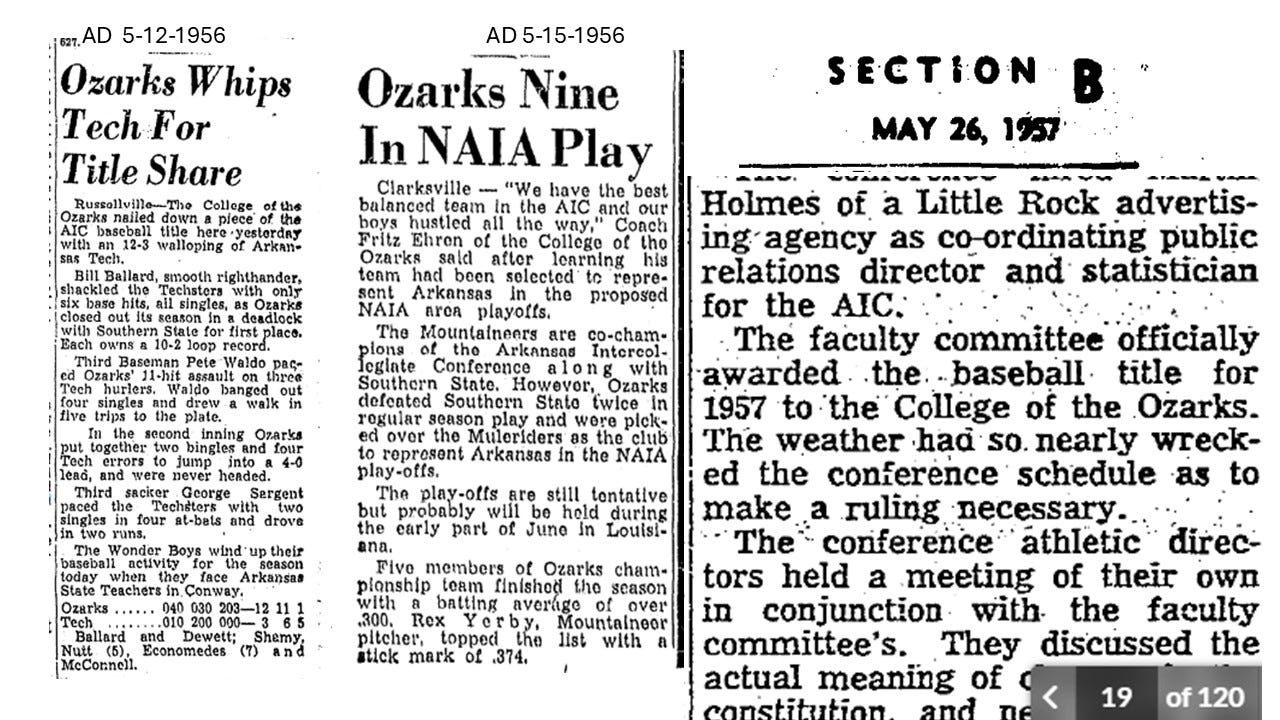
I was pretty sure that Ozarks won two consecutive AIC baseball titles in the 1950’s, but when I checked the last Review of Sports (1994), Ozarks was only listed as the AIC baseball champion in 1957. When I used an earlier Review of Sports (1962), the list of baseball champions lists Ozarks and SAU as Co-Champions in 1956. I then reviewed the newspaper articles from 1956 and found that the older ROS is correct. I have posted the newspaper stories that confirm that CofO and SAU tied for the title in 1956, and Ozarks was chosen to represent the conference in the NAIA National Tournament.