
Backroads and Ballplayers #140
Stories of the famous and not-so-famous men and women from a time when baseball was “Arkansas’ Game.” Backroads and Ballplayers Weekly is always free and short enough to finish in one cup of coffee.

The 1942 Travelers, Jittery Joe’s Lost Story, Road Trip to the University of the Ozarks, Pitchers and Catchers Report, BUT…

________________________
Road Trip to a “Field of Dreams”
I never met Lonnie Qualls, but I got to know his family when his son Brian and I shared a hobby. I had heard about the excellent new facilities at the University of the Ozarks, and on a Friday morning with some time for a drive, I found a college baseball game at the beautiful field that bears the name of UoO’s beloved “Coach Qualls.”
I have discovered that Division II and Division III baseball remind me of the “Town Team” days in Arkansas’ baseball history. Nothing about the baseball field or the Wilson Athletic Complex on the UofO campus has any resemblance to the dirt infields of the local ballparks of the 20th century.

The facilities at the UofO defy expectations for a small-town Division III school and would be worth a visit even if it weren’t a game day for any of the Eagles’ teams. The Wilson Complex represents a shared vision and a community’s generous commitment to small-college sports.
Congratulations to the University of the Ozarks, and thanks for the warm welcome from the Sports Information Director, Josh Peppas, who happens to be from my hometown. Josh is among the most experienced and well-respected SIDs in Arkansas. We could have talked all day, but it was Game Day at Lonnie Qualls Field. I will be back.
Baseball and World War II
Arkansans who lived during the war years of the 20th century struggled through some of our state’s most difficult days. They were part of a legacy that Tom Brokaw would later denominate as “America’s Greatest Generation.” By 1942, our grandparents had lived through World War I, the Flood of 1927, a devastating drought, and the Great Depression.
They had escaped the reality of those hard times through church, radio, and the St. Louis Cardinals. Perhaps by the early 1940s, the inevitability of another crisis had already tempered the optimism of President Roosevelt’s New Deal. That fear became a reality on December 7, 1941. World War II would be the most difficult of all the challenges faced by the Americans in the 20th century, and a serious threat to America’s Pastime.
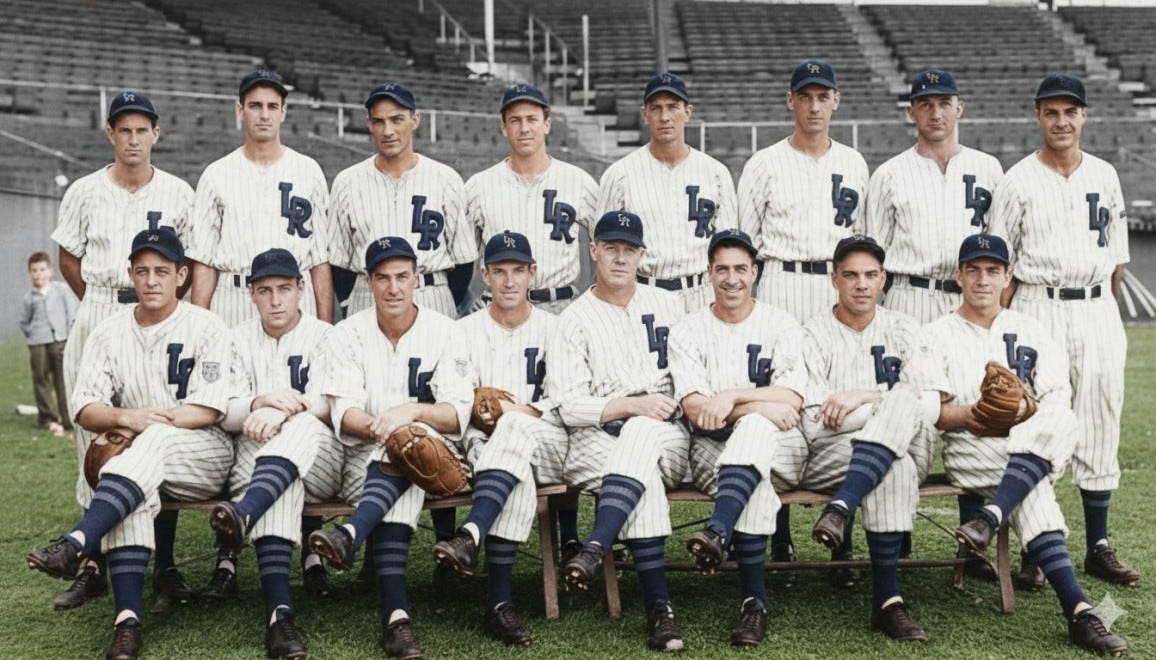
Optimistically, on December 5, 1941, the National Association, which governed minor league baseball, had met in Jacksonville, Florida, to finalize plans for the 1942 season. Forty-nine minor leagues and more than 300 teams were represented. By 1944, that number would be reduced to nine minor league circuits. The venerable old Southern Association and the Little Rock Travelers would survive. Included in those perilous years in the history of minor league baseball was the year the habitually second-division, Little Rock Travelers, won a pennnat.
1942 The Green Light and a Pennant in Little Rock
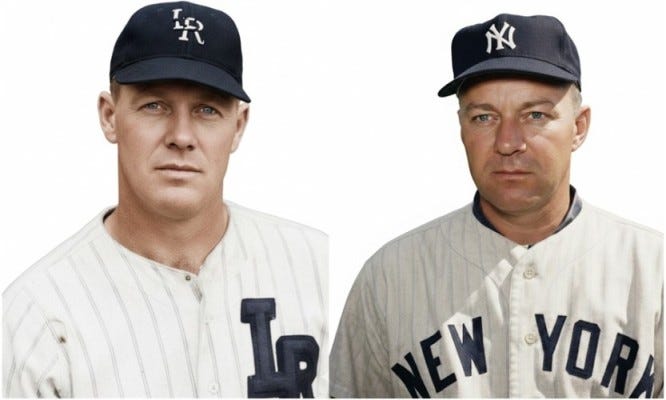
The amazing story of a perennial second division team winning the Southern Association pennant is a feature in Only in Arkansas today (Tuesday, February 17). Please follow this link to the story and share it with others you think would be interested.
A Green Light and a Pennant in Little Rock, Only in Arkansas.
________________________
Too Old!
Before we move to some current baseball thoughts, one final lost story about an Arkansas-born pitcher who thrived in World War II. Why? Because the military did not want him.
A look at Jittery Joe Berry’s career gains some perspective in relation to 25 years of baseball’s legendary stars. When Berry broke into baseball in 1927, Babe Ruth was in the process of hitting 60 home runs for the legendary “Murderers Row.” The Yankees’ lineup also included a 24-year-old kid named Gehrig, who drove in 173 runs. Mickey Mantle, Willie Mays, and Hank Aaron were yet to be born.
Berry pitched against Bill Dickey, Joe DiMaggio, and Ted Williams. He was almost twice the age of fellow Arkansan George Kell when they were teammates in 1944. He witnessed history from 60 feet away, pitching to Jackie Robinson in Canada in 1946, and when Berry retired in 1951, Mantle and Mays were rookies taking New York by storm. Ruth and Gehrig were deceased.
Berry debuted in 1927 for Laurel, Mississippi, at age 22. He made his first big-league debut in 1942 when he made two ugly appearances for the White Sox at age 37. Since the military was not interested in him, he got another shot in 1944. This time, he immediately became the best relief pitcher in the Major Leagues. In 1944 and 1945, he led the majors in games pitched, saves, and games finished. His career marks in pro baseball (major and minor league) include 235 pitching wins and 3,529 innings pitched.
Jonas Arthur Berry from Madison County, Arkansas, pitched in 936 games in 24 summers of professional baseball. He played on teams in 20 cities and towns across the United States, from Laurel, Mississippi, to Los Angeles, California, and he holds the rare distinction of having played pro baseball in four decades from the 1920s to the 1950s.
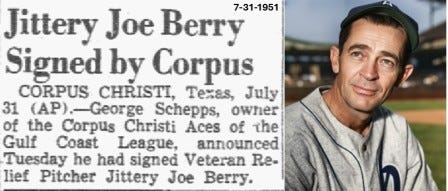
Joe Berry got his last call in 1951 at age 46, when he was signed by the Gulf Coast League Champion, Corpus Christi Aces, to help the team in the playoffs. He was the winning pitcher in the Aces’ last game of the season.
Jonas Berry lost his life in a traffic accident in Anaheim, California, on September 27, 1958, at age 54. He is buried in Huntsville, Arkansas, under a gravestone inscribed “Jittery Joe Berry.”
_________________________
Pitchers and Catchers Report, but…Are there dark days ahead?
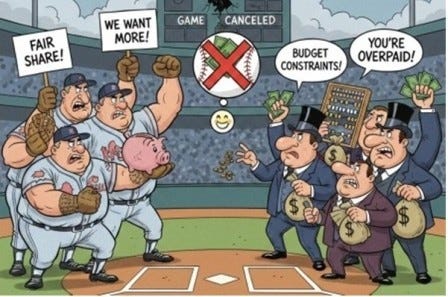
“Let’s fix this, but not by me,” (the players). “Let’s fix this, but not by me,” (the owners). How about a long, ugly game of chicken, featuring a lockout?
Team spending over the last five seasons:
(Payroll plus Competitive Balance Tax)
Mets: $1.8. Dodgers: $1.7, Yankees: $1.5. Yes, those are billions,
And these are millions: A’s $347, Pirates $356
The current Major League Baseball collective bargaining agreement expires on December 1, 2026, at 11:59 p.m. ET. This labor agreement, which was finalized in 2023, will govern the league through the 2026 season.
Prediction: Neither the owners nor the Players Union will see the big picture and enter negotiations for a new agreement with a willingness to reach a consensus.
____________________
Be sure to read and share the story of the 1942 Pennant in Little Rock.
_____________________
Important information about access to Backroads and Ballplayers Weekly
If you do not want to miss these posts, you can subscribe or save the address to the Backroads and Ballplayers Facebook Page. Instructions below:
A Subscription sends these weekly posts to your mailbox. There is no charge for the subscription or the Backroads and Ballplayers Weekly.
If you don’t want to subscribe, you can find the weekly posts on Monday evenings at Backroads and Ballplayers on Facebook. SAVE THE LINK
Next Week - Nashville Cubs, Some lost baseball stories from the University of the Ozarks, and New Faces at Baum Walker