
Backroads and Ballplayers #138
Stories of the famous and not-so-famous men and women from a time when baseball was “Arkansas’ Game.” Backroads and Ballplayers Weekly is always free and short enough to finish in one cup of coffee.

Play Ball! Mystery Photo, Lost Story of “Dr. Baseball,” and Flying in from the Bullpen.”
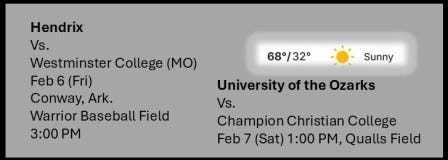
Play Ball! Looking for a ballgame?
Mystery Photo January 2026
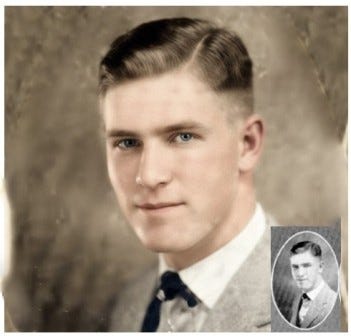
From his yearbook: “A real Jack of All Trades is this brain-storm who dropped in on us. He played the hero in Peg o’ My Heart…, drums in the Jazz Orchestra, the manly Duke in ‘Vodville,’ and havoc with the lady’s hearts. Certainly, some man.”
I am sure you recognize this young baseball star “out of uniform.”
Message Jim Yeager if you have a guess…
____________________
More Town Team
In keeping with the town team theme that has dominated my thinking since reading Homestand by Will Bardenwerper, I am revisiting one of my all-time favorite lost stories, the life of Dr. E. T. Williams of Greenbrier, Arkansas. Dr. Williams was the father of semi-pro baseball in Arkansas, the founder of the Greenbrier Baseball School, and the mentor behind about 75 young men who signed pro contracts in the first half of the 20th century.
January 29, 1951, The Lost Story of The Passing of “Dr. Baseball”
This week, 75 years ago, Arkansans were reading the news that the Father of Arkansas amateur baseball had succumbed to a heart attack in Greenbrier on January 29. I have never found evidence that Dr. Earl Williams ever played in an organized baseball game, but he loved the game, and I suspect he played when he was young.
Dr. Earl T. Williams arrived in Greenbrier and established a medical practice around 1908. By all accounts, he was the living example of the beloved country doctor, but reviews of his medical practice are scarce. To venture into hyperbole, Dr. Earl Williams had more impact on amateur baseball in Arkansas than anyone who ever lived. His work in baseball made headlines and earned him national recognition, but like his medical career, his work during the heyday of town team baseball has become a lost story in Arkansas baseball history.
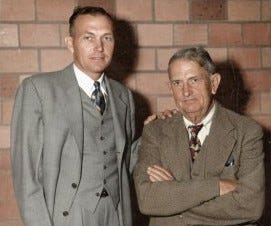
A country doctor makes Greenbrier the center of early 20th-century baseball in Arkansas.
In the 1930s, the Sunday Edition of the Arkansas Gazette featured a “magazine” section, not unlike the special inserts in the Sunday editions found in today’s large newspapers. The Arkansas Gazette Magazine allowed for more in-depth articles and often featured stories on the accomplishments of notable Arkansas citizens. The Sunday magazine of June 23, 1935, featured a lengthy article about Earl T. Williams, a country doctor from Faulkner County.
Surprisingly, Dr. Williams’ tribute did not mention his extraordinary work as a rural doctor, although his contributions in that field were likely significant. The glowing feature by columnist V. V. Quertermous focused on Williams’ leadership in developing Arkansas baseball players. In retrospect, while his contributions to Arkansas’ baseball before 1935 were significant, Williams’s most important work was still ahead.
Dr. Earl T. Williams was born near Hannibal, Missouri, in 1881 and arrived in Greenbrier, Arkansas, to establish his first practice in about 1908. His interest in baseball originated in his youth, and although he did not have the skills to play professional baseball or the time to hone those skills, he possessed a deep love for the game.
By 1913, Dr. Williams had become the coach of the local town team in Greenbrier, and in 1916, he helped establish a semi-pro league called the Faulkner County League. In the early 1920s, Williams’s interests began to evolve as his involvement in amateur baseball grew.
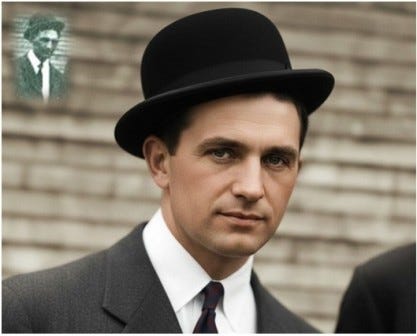
Traditionally, the manager of a semi-pro team found players, scheduled games, and made a lineup. Perhaps influenced by his advanced education, Williams became interested in player development. He continued to look for talent, but Williams took an extra step, uncommon in semi-pro baseball. He coached. Williams studied player skills and drilled his players on proper technique. He became what in today’s sports jargon is called “a student of the game.”
The success of Williams’ semi-pro teams did not go unnoticed. Not only was the Greenbrier semi-pro team successful as a unit, but individual players on the team also began to get noticed. As a result, Williams’ players caught the attention of professional baseball scouts, and young men from tiny hamlets in North Faulkner County, Arkansas, began signing minor league contracts. The first of these was Otis Brannan of Greenbrier, who had been an outstanding college baseball player at Arkansas State Normal School (University of Central Arkansas), as well as a star on the Greenbrier semi-pro team. Brannan would become the first player mentored by Dr. Williams to make the major leagues when he became the starting second baseman for the Saint Louis Browns in 1928. He would play professional baseball for 13 seasons.
Although Otis Brannan was the first player who played under Dr. Williams to reach professional baseball and the first to reach the major leagues, he was closely followed by more Greenbrier-trained players in the late 1920s. Among these were Dr. Williams’ two oldest sons.
Royce, the oldest Williams brother, graduated from Hendrix College in 1924, after a stellar career in four sports. By 1929, Royce Williams was 26-years old and had worked his way up through the minor leagues to become the starting second baseman for Class A Memphis in the Southern Association. The oldest of the Williams brothers would have a ten-year pro baseball career and play more than 1,000 games, but never reach the major leagues.
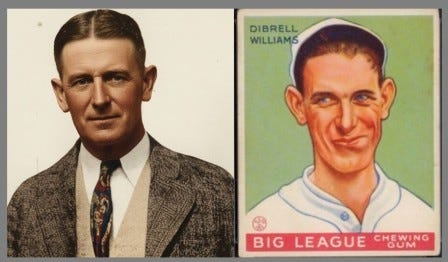
Dr. Williams’ middle son, Dibrell, came home from college in the spring of 1929 and became an immediate success that summer with the Little Rock Travelers. By the winter of 1930, he had been signed by the Philadelphia Athletics. Dib Williams became Greenbrier’s second major leaguer the next spring. Dib Williams would play 475 major league games and another 1200 plus minor league games. He was part of two pennant-winning seasons for the Philadelphia A’s and batted .320 in the A’s 1931 World Series appearance.
A third son, Gene, was eight years younger than Dib and would break into pro baseball in 1936 with Batesville in the Northeast Arkansas League. The younger of Dr. Williams' sons was not as successful in professional baseball as his older brothers. His lifetime record in Baseball Reference.com is inaccurate, but he very likely played four years of minor league baseball.
Dozens of North Faulkner County young men who trained under Dr. Williams joined Otis Brannan and the Williams brothers in pro baseball in the next decade. By the late 1930s, the country doctor had become the most influential and respected person in Arkansas baseball. In 1938, Dr. Williams decided to take on his most ambitious endeavor.
Doan’s Baseball School was drawing in excess of 300 young men with major league dreams to Hot Springs, Arkansas, each February. Big league instructors made the school attractive, but February in Hot Springs was often bitterly cold.
Hot Springs also had a rather rowdy reputation, and some families were reluctant to send their inexperienced young sons to a town with unfamiliar temptations. Obviously influenced by the baseball school concept, Dr. Williams came up with what he thought was a better idea: a baseball summer school in a mom-approved, less distracting town.
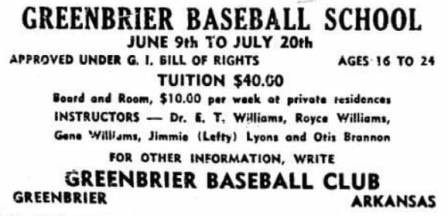
In April of 1938, an ad in the Arkansas Gazette announced the inaugural Greenbrier Baseball School opening in June of the coming summer. Dr. Williams had the name recognition and respect in Arkansas and neighboring states that gave his fledgling summer baseball school instant credibility.
The Greenbrier Baseball School would feature instruction by Williams and his sons, Royce and Gene, in a rural setting devoid of “honkytonks, beer joints, and pool halls.” Tuition would be the standard $40, but for $10 more per week, the young men would be housed by families and fed home-cooked meals.
The first Greenbrier Baseball School enrolled 30 young men in the summer of 1938, and the school was declared an instant success. Some of this success was due to the fortuitous arrival of a tall, lanky first baseman fresh from his high school graduation in Memphis.
Doc Williams immediately converted the talented lefty to a pitcher, and Gene Bearden became the outstanding player of that first summer baseball school. Bearden attracted scouts to Greenbrier throughout the summer and created opportunities for other participants to catch the attention of pro scouts. Williams reported in July that five young students had signed professional contracts.
In 1939, after his second summer school, Dr. Williams announced that several more students had signed with minor league teams. Among those inking minor league contracts was William Thrace “Square Jaw” Ramsey, a fleet-footed outfielder from Osceola, Arkansas.
Ramsey and Gene Bearden would eventually reach the major leagues, and Bearden would become the hero of the 1948 World Series. The Greenbrier Baseball School was off to an impressive start on a 13-year run that produced dozens of professional baseball players.
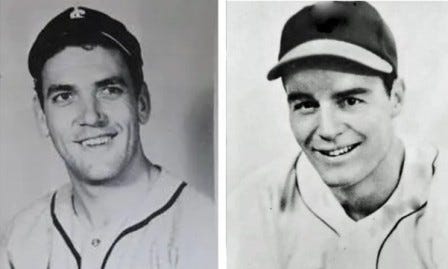
Although Bearden and Ramsey would be the only major leaguers to come from the Williams school, the Greenbrier Baseball School continued to be a popular summer destination for aspiring baseball players throughout the war years, and Dr. Williams became nationally recognized for his leadership in amateur baseball. In 1941, the Amateur Baseball Congress named Williams as the “National Amateur Baseball Leader of the Year.”
In 1947, Arkansas State Teachers College, in nearby Conway, Arkansas, called on Dr. Williams to help the college revive the school’s dormant baseball program. Williams, assisted by his son Dib, coached the team in the spring of 1947, and Dr. Williams taught a class to train future coaches. Ninety students enrolled in the class, and according to the ASTC yearbook from 1947, the “highlight” of the new program occurred when Yankee great Bill Dickey visited the school at Williams’ request, to help build interest in baseball.
In an interview with the Arkansas Gazette in 1949, Dr. Earl Williams fielded the tough question that baseball historians ponder in researching his outstanding career. Columnist Joe McGee asked the 68-year-old country doctor, “What would you do if you had a baby case and there was a ball game at the same time?” Doc Williams replied, “I’d be at the game, I guess.”
Flying in From the Bullpen
A team coached by Dr. Williams never won the Arkansas State Semi-pro Championship. A controversial final day in the 1938 tournament was as close as he came.
In 1938, Arkansas had made Dr. Williams the Commissioner of Arkansas Semi-Pro Baseball. He was responsible for organizing an Arkansas State Semi-Pro Tournament, sanctioned by the National Baseball Congress.
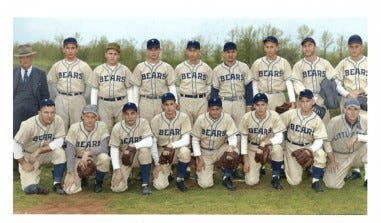
When the tournament opened in mid-July, the Greenbrier Baseball School was the favorite to take home the title. Williams entered two teams; his best students made up Greenbrier Baseball School Number 1 and featured future World Series hero Gene Bearden. A second entry was designated as Greenbrier Baseball School Number 2.
Greenbrier Number 1 made it to the finals without a loss. Their opponent, the Little Rock Research Hospital, had worked through to the losers’ bracket with their ace Bryan Hammett pitching in every game.
Bearden lost to Hammett 7-1 in the first game of the doubleheader to decide the championship, but with their only dependable pitcher used in game one, Little Rock Research Hospital was out of pitchers. Greenbrier Baseball School still looked like the team to beat.
Hammett had pitched a complete-game victory in the first game, and, at best, he could only offer a few innings in the deciding game. With a state championship and some professional pride at stake, a Little Rock doctor with ties to Research Hospital commandeered a private plane to fly an eligible pitcher, Ed Herndon, from Little Rock to Fort Smith, the site of the tourney.
With the fly-in pitcher holding the tough Greenbrier lineup in check until Hammett relieved for the last two innings, the Little Rock squad prevailed 5–3. Hammett was the winning pitcher in both contests. It was not William’s last tough loss in the state tournament. The next year, a team from Ozark defeated a new Greenbrier Number 1 in the finals. Although he is credited with the success of amateur baseball in Arkansas, Dr. Baseball never won a state semi-pro title.
__________________________
Important information about access to Backroads and Ballplayers Weekly
If you do not want to miss these posts, you can subscribe or save the address to the Backroads and Ballplayers Facebook Page. Instructions below:
A Subscription sends these weekly posts to your mailbox. There is no charge for the subscription or the Backroads and Ballplayers Weekly.
If you don’t want to subscribe, you can find the weekly posts on Monday evenings at Backroads and Ballplayers on Facebook. SAVE THE LINK
_______________________________
Wow. Dr. Williams did a whole lot for Arkansas baseball. I can see how he developed a big interest and it wouldn't be his career per se, since he was a doctor, but he still loved the game so much that he put in so much effort on the side. That shows real passion for sure. Great article, Jim.